About Mycal (マイカル)
Page about mycal,a technologist, maker-hacker, Burner, musician, and systems philosopher whose work spans four decades: from 1980s tunnel exploration and pirate radio to embedded microstacks, wireless ISPs, silicon TCP/IP, identity-based remote access, and now AI-programmable compute.
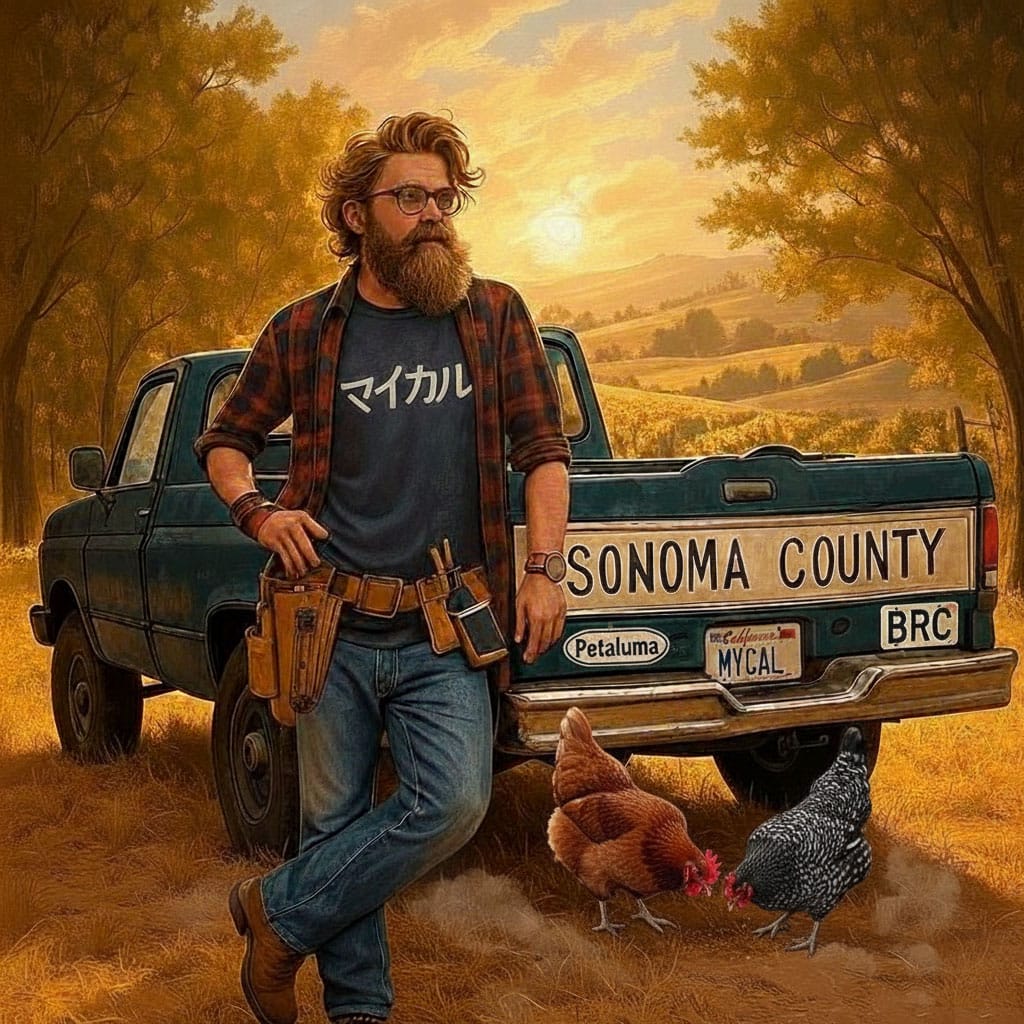
Technologist · Maker-Hacker · Burner · Musician · Cronofuturest
I’m Mycal (Mike Johnson) — a technologist, maker-hacker, Burner, musician, and systems philosopher whose work spans four decades: from 1980s tunnel exploration and pirate radio to embedded microstacks, wireless ISPs, silicon TCP/IP, identity-based remote access, and now AI-programmable compute.
Everything I build follows a single pattern:
Energy → Flow → Computation → Meaning.
Origins: 1980s Tunnels, RF, Unix & Early Internet
Tunnels & Infrastructure Exploration (1983–1988)
My story begins in the steam tunnels under Chico State — a hidden world of pipes, valves, pressure loops, and humming mechanical systems.
These tunnels were my first systems laboratory, teaching me:
- follow the flow
- respect the pressure
- abstractions sit on sweating pipes
- infrastructure is the first teacher
Those nights underground shaped my entire engineering worldview
Pirate Radio & RF Hacking (1980s/90s)
At the same time, I began running pirate radio stations (CSUC) with both commercial RF gear and improvised antennas, running tiny FM stations.
This work eventually led me into the micropower radio movement, where I later collaborated with Stephen Dunifer of Free Radio Berkeley and designed and built many DIY designs that let a thousand radio stations bloom.
RF hacking taught me:
- resonance & propagation
- amplifier design
- how energy becomes information
- and the politics of open communication
President of ACM (1987)
In 1987, I served as President of the ACM chapter at Chico State, bridging my underground systems exploration with the emerging discipline of computer science.
This marked the moment my curiosity became a formal craft.
AT&T 3B5 Unix, Early Usenet & Proto-Internet (1987)
That same year, I began working on the AT&T 3B5, one of the earliest Unix mainframes available to students.
There I experienced:
- multiuser Unix
- early networking stacks
- UUCP mail and Usenet
- distributed messaging
- long-haul connectivity before the modern Internet
This was my initiation into distributed systems — the thread that has run through everything since.
Everex Graphics Research Lab (1989–1991)
From 1989 to 1991, I worked in the Everex Graphics Research Lab, developing early VGA/SVGA graphics pipelines and multimedia systems.
Here I learned:
- framebuffer architectures
- low-level timing loops
- Windows graphics drivers
- chip-level debugging
- multimedia acceleration
- Managing Dialup UUCP (mail and Usenet newsfeed) nodes
This refined the low-level intuition that later appeared in my embedded tools, VGA audio analyzers, and micro-TCP/IP stacks.
Embedded Systems, Early Web, and Micro-Networking
Embedded TCP/IP Microstacks (1990s–2000s)
Throughout the 1990s, I created ultra-small TCP/IP stacks for microcontrollers — long before “IoT” existed.
These included:
- ARP, DHCP, ICMP
- UDP/TCP
- SLIP/PPP
- link-layer shims
- sub-kilobyte runtimes
Ideas from this work still echo in NuttX, and in tools that evolved into descendants of Conky and other embedded monitoring systems.
These microstacks became the software DNA that eventually moved into silicon.
Group42 HTML CD-ROM (1994–1997)
My early digital culture is preserved at https://www.group42.net home of the Group42 Sells Out HTML CD-ROM, a 1990s artifact of early web publishing, essays, tools, and maker-hacker culture.
It remains one of the earliest, if not first “HTML-on-CD” releases. We started this in 1994 when we discovered the file:// and had access to an early pioneer CD burner used by our company to backup data. First production burn in march 1995.
Real Internet Infrastructure: ISP, BGP & Routing
SVN.NET — Early Wireless ISP & Backbone Systems (1996–2003)
I founded SVN.NET (Silicon Valley North), one of the first wireless broadband and dial-up ISPs in the United States.
Here I learned how the real Internet works:
- BGP routing & peering
- owning and operating our own CIDR block
- CLEC interconnects & telco provisioning
- PPP/PAP/CHAP/RADIUS dial-up systems
- mail, DNS, and hosting architectures
- large-scale Usenet feeds & NNTP propagation
- CGI, PHP, early dynamic web
- long-range RF links & distributed access points
SVN.NET overlapped with my early silicon networking work — one taught me networks in the wild, the other taught me networks in silicon.
Silicon Networking: TCP/IP in Hardware
iReady — First TCP/IP in Silicon (1996–2004)
I co-founded iReady, the first company to put TCP/IP into silicon.
We built:
- hardware TCP engines
- protocol micro-cores
- state machines
- DMA-driven packet pipelines
- embedded network processors
iReady unified my ISP experience with my embedded microstack work.
Nvidia MCP55 — Hardware TCP Offload (2004–2006)
After iReady was acquired by Nvidia, I joined their server silicon team, working on MCP55:
- hardware-accelerated TCP
- embedded control CPUs
- low-latency offload engines
- ultra-efficient packet pipelines
This was the precursor to my later interest in AI-driven compute and networking.
Identity-Based Access & Device Overlays
Yoics → Weaved → Remote.it (2007–2020)
I spent more than a decade building identity-based remote access tools:
- NAT traversal without port forwarding
- identity-scoped device access
- encrypted tunnels
- ephemeral routing
- tiny embedded daemons
- cloud-managed onboarding
Remote.it became the philosophical predecessor to NoBGP.
Fire Art, Burning Man & Reared in Steel
Large-Scale Fire Art Systems (2010–Present)
I’m a longtime Burner and a member of Reared in Steel, where I design and build the:
- computer systems
- MIDI engines
- DMX/MIDI hybrid controllers
- sequencing logic
- safety interlocks
- distributed timing systems
…for large-scale fire art.
Some of this work is published publicly on GitHub.
Fire art merges everything I love:
entropy, timing, risk, engineering, and transformation.
Ashes and Echoes – Songs from the Playa (Burning Man 2025)
In 2025, I released Ashes and Echoes – Songs from the Playa, a full-length Burning Man–inspired album exploring transformation, entropic beauty, fire, memory, and the emotional architecture of Black Rock City.
It blends roots-folk, ambient electronica, Cronosonics narrative elements, and Playa field textures into a cohesive sonic experience.
Tracks like:
- Ash and Echoes (The Temple Song)
- We Did Start the Fire (Burningman History Jam)
- Burner Girl
- Ten Principles, One Heart
- Weird Steel
…map the emotional and cultural terrain of Burning Man through music, story, and sound design.
The album is part of the Cronosonics aesthetic — my ongoing project that fuses sound, cognition, memory, and narrative.
Modern Work: AI, Compute, Cognition & Narrative
NoBGP — AI-Programmable Compute Overlay (2024–2025)
I’m building NoBGP, a federated overlay that lets LLMs deploy, route, authenticate, and orchestrate compute through natural language.
Its foundations:
- identity-scoped routing
- ephemeral compute
- policy-enforced orchestration
- human co-regency
- multi-model collaboration
MCP — Model Context Protocol
A structured communication layer that allows AI agents to extend themselves, request capabilities, and collaborate safely across identity boundaries.
Cronosonics — Music, Time & Cognition (2024–2025)
Cronosonics is my multimodal aesthetic — the fusion of sound, narrative, memory, and AI. This was created for this blog!
It explores how sound becomes memory and memory becomes story.
It is the 2nd format I invented after HTML format CD-ROMs.
Archives: The Technical Record
Most of my early engineering history is preserved at:
👉 https://archive.mycal.net/projects
Philosophy: Energy → Flow → Computation → Meaning
Across radio, tunnels, microstacks, silicon, fire art, and AI:
Energy becomes flow.
Flow becomes computation.
Computation becomes meaning.
Entropy pushes outward.
Understanding pushes back.
Why I Write
To preserve:
- the hidden systems under the systems
- the lineage from embedded → silicon → AI
- the hacker-maker culture of the 80s/90s
- the path from entropy to understanding
- the memories that shape the machines we build
My work connects the past’s pipes, packets, and silicon
to the future’s agents, overlays, and cognition.
Timeline
1983–1986: Chico State tunnels, Chico Stacks, infrastructure exploration, pirate radio (csuc)
1987: ACM President • AT&T 3B5 Unix • early Usenet
1989–1991: Everex Graphics Research Lab, dialup UUCP node
1991–1992: Token Ring Routers and Bridges, 56Kbps Frame relay drivers for Linux Kernel driver development
1990–1995: Micropower radio & RF engineering
1993–1997: Group42 HTML CD-ROM • embedded microstacks
1996–2003: SVN.NET – wireless ISP, BGP, CIDR, Usenet
1996–2002: iReady – first TCP/IP-in-silicon
2002–2004: Nvidia MCP55 – hardware TCP offload
2006–2020: Yoics → Weaved → Remote.it
2010–Present: Reared in Steel fire-art systems
2024–2025: NoBGP netwrok overlays, AI MCP's and frictionless control
2025: Ashes and Echoes – Songs from the Playa
2025: Cronosonics, blog.mycal.net