My Warehouse 13: The Attic That Kept My Timeline Intact
Every maker has a Warehouse 13 — a space where time pauses and artifacts wait. Mine sits above my old shop, unchanged for decades, holding pirate transmitters, burned CDs, notebooks, dead tech, forgotten futures. This is the story of climbing back into the past to understand the person who built it.
Tinkering with Time, Tech, and Culture #30 - Warehouse Series I
Every technologist eventually builds a museum.
Most don’t realize it until they’re standing inside one.
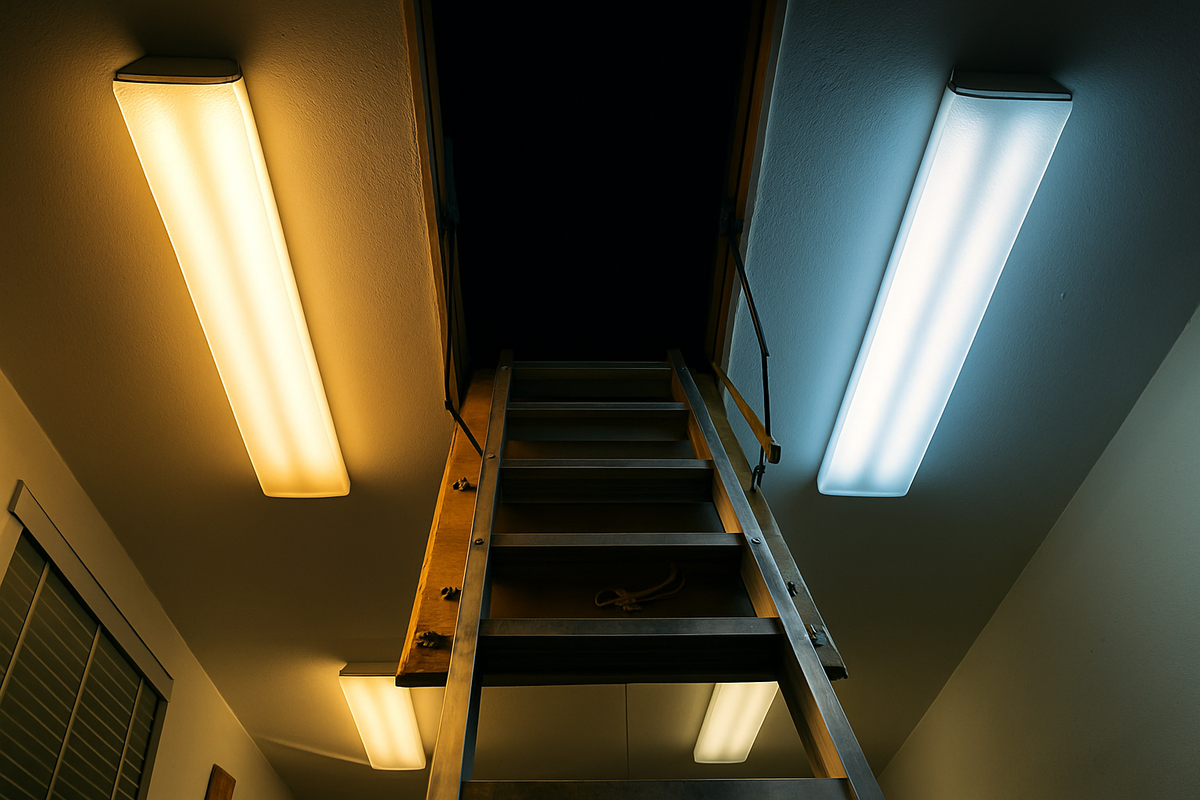
Mine lives above an 800-square-foot building on a couple of acres just outside the Petaluma city limits — a shop, an office, a lab, a sanctuary — and an attic that accidentally became my own personal Warehouse 13.
It didn’t start as a warehouse.
It started as momentum.
The First Lab
A few years out of college, newly married, and full of that early-adult belief that the future is nothing but forward motion, we bought a home “out in the country.”
In Petaluma, that means:
- a couple acres of grass and mud,
- a well pump that complains in the winter,
- and enough sky to convince you you’re building something of your own.
The very first thing I did wasn’t landscaping or painting or decorating.
I built a building.
Eight hundred square feet of pure possibility —
part shop,
part office,
part lab,
part man-cave,
part identity.
Mycal’s Lab.
Mycal Labs.
The name shifted as the eras did, but the meaning never changed.
And right when the building was finished, the artifacts arrived.
The Dumping of The Past
My parents showed up with everything they’d saved for me:
- My Apple II+
- Electronics magazines from the era when hobbyists ruled the earth
- Early ham radio projects with handwriting I barely recognize
- My Chico-era FM transmitter and its Frankenstein support equipment
- Books whose edges I’d worn down learning how to bend electrons
- Boxes of college textbooks, notes, letters, reports
These objects didn’t come with ceremony.
They went straight into the attic above the lab — a time capsule placed directly on top of the next chapter of my life.
From that moment on, the attic began to fill.
Not quickly.
Not deliberately.
But inevitably.
Projects.
Failures.
Letters.
Textbooks.
Weird science curiosities.
Dead-company test equipment.
Parts overruns from products I built.
Geiger counters.
Artifacts from Chico.
Artifacts from the Valley.
Artifacts from HSC and WeirdStuff.
Artifacts from nights when inspiration struck at 1 a.m.
Artifacts from days when nothing worked but I couldn’t throw it away.
I didn’t save them because I was nostalgic.
I wasn’t.
(Not then.)
I saved them because I never believed the story was over.
The Move That Should Have Broken the Timeline
Life pivoted, as it does.
I moved to Silicon Valley for several years — the gravitational pull of ambition, opportunity, and constant pressure.
We rented out the house, but the shop was exempt, off-limits to tenants.
Locked.
Untouched.
Preserved.
The lab stayed intact.
The attic stayed intact.
The timeline stayed intact.
That almost never happens.
Moves destroy artifacts.
They scatter history.
They prune stories you didn’t mean to prune.
They break the linearity of time.
But mine stayed still.
When we moved back to Petaluma, something surreal happened:
Within two weeks, it felt like nothing had changed.
Tools in the same positions.
Half-finished projects exactly where I’d left them.
Dust patterns that made no sense unless time itself had paused.
It was as if the Silicon Valley years were a dream I had woken from.
That’s when I realized:
I hadn’t built a shop.
I’d built a time machine.
Digging in the Archive
Lately, I’ve been excavating.
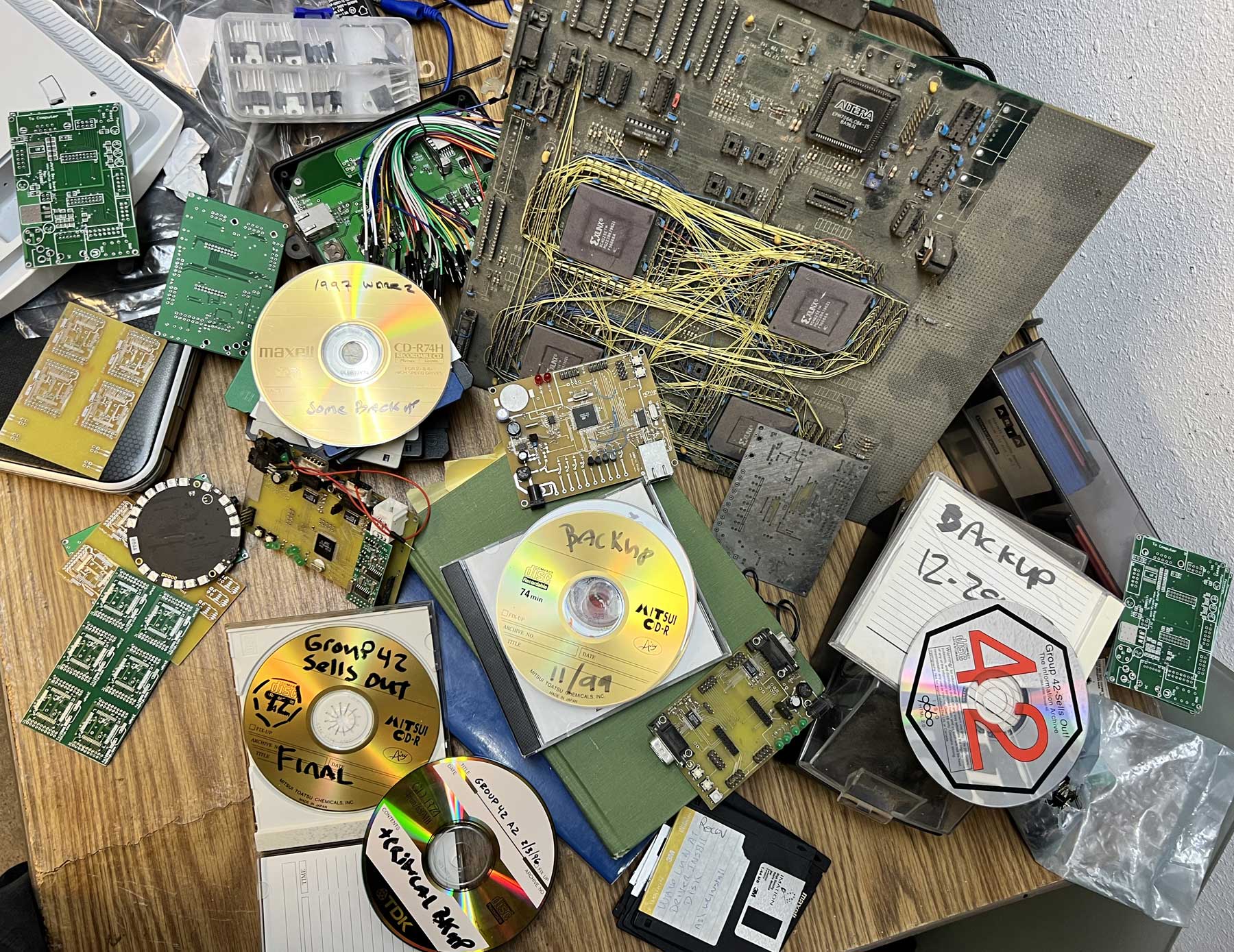
Pulling out hand-burned CD-ROMs from the ’90s.
Feeding 5.25" and 3.5" floppies into USB drives to see which ones spin up.
Reading notebooks written by a version of myself who had no idea who he would become.
Finding electronics projects from 40 years ago — sketches, circuits, experiments, unfinished ideas preserved like insects in amber.
Some of it still works.
Some doesn’t.
Some of it feels like it shouldn’t have ever worked at all.
Each object is a memory with weight.
A breadcrumb in a long walk through time.
A coordinate in the map of a life spent tinkering at the edge of possibility.
The attic isn’t storage.
It’s continuity.
My Warehouse 13.
What Makes Something an Artifact?
Artifacts aren’t defined by age or rarity or monetary value.
They’re defined by meaning that survives time.
An artifact is:
- a circuit that still boots
- a notebook full of ideas you weren’t ready to build
- a CD-ROM burned on a machine that no longer exists
- a letter from a past version of yourself
- a piece of test equipment from a company that died but mattered
- a scribbled sketch that became the root of a future career
- a childhood project that shaped everything that came after
Artifacts survive us.
Artifacts remember when we forget.
Artifacts anchor us.
Every technologist builds a warehouse like this, even if they never name it.
Mine just happens to be an attic on a couple acres north of San Francisco.
Why It Matters Now
Because we live in an era where the digital world forgets fast, and the physical world breaks even faster.
Because memory without material is fragile.
Because provenance is becoming the new currency.
Because meaning has no guarantee unless we choose to preserve it.
And because the artifacts in my warehouse — the CD-ROMs, the transmitters, the test equipment, the Apple II+, the floppies, the notebooks, the failures, the sparks — are no longer just relics.
They’re anchors of identity in a world that dissolves context at incredible speed.
This whole warehouse — accidental, chaotic, cluttered — is the physical record of a life spent building things, breaking things, fixing things, inventing things, and refusing to throw away the parts that mattered.
The attic didn’t just hold my past.
It held my continuity.
Every technologist has a Warehouse 13.
This one is mine.
Next in this series: The First Warehouse: The Chico Stacks