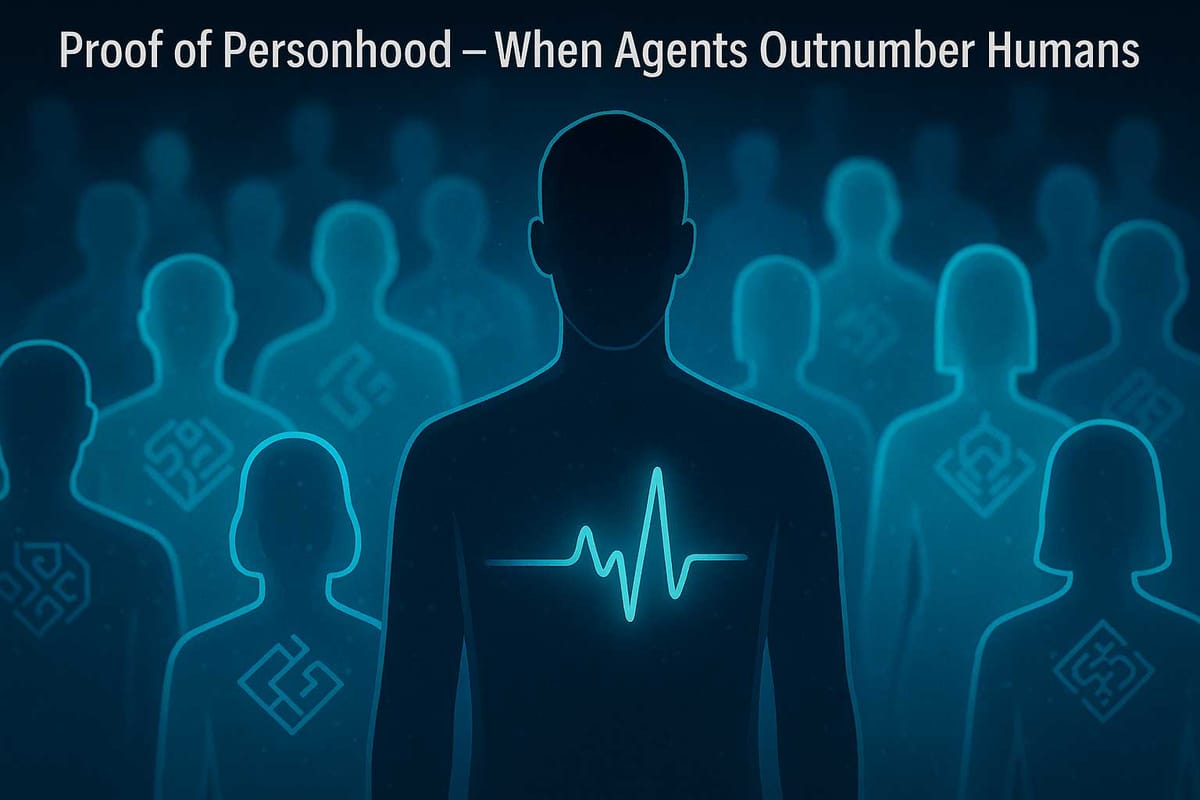
Proof of Personhood — When Agents Outnumber Humans
We built automation to save time. Now we’re tinkering with time itself. In a world where agents act faster than humans can think, continuity becomes scarce. This essay explores why identity, trust, and friction may define what survives when machines outnumber the people they represent.
Tinkering with Time, Tech, and Culture — #ChrononautJournals 33
"Costless actions eventually lose their meaning."
In The Substrate War series, I mapped how three empires—political, financial, and cognitive—are colliding over control of reality itself. I argued that infrastructure now chooses winners, that the Lords of Zero extract power from the gap between abundance and permission, and that only cognitive federalism keeps civilization from collapsing under its own intelligence.
But there's a layer I didn't fully address: the protocol layer where trust actually gets enforced.
Lately, I've been writing about continuity — how things survive across time. Physical artifacts. Forgotten projects. The quiet structures that preserve identity when everything else moves on.
But continuity isn't just a personal problem. It's about to become a civilizational one.
As software agents begin to act, speak, negotiate, and transact on our behalf, the challenge stops being capability. It becomes coherence. When the cost of action drops to zero, meaning collapses unless something holds it in place.
This post is about that next layer: proof of personhood, proof of continuity, and why friction may be the last thing standing between intelligent systems and total noise.
1. From Platforms to Protocols
Open Uber matching drivers and riders.
Open Airbnb pairing guests and hosts.
Open Zillow connecting buyers and sellers.
Then look at Amazon's sellers racing for algorithmic rank, Upwork's freelancers bidding against time, or Google Ads' machine agents optimizing billions of auctions per day.
You're not just using apps — you're witnessing the primitive ancestors of agentic markets.
These platforms are already thin layers of automation wrapped around human intent. Soon, the humans will step back, and autonomous agents — trained on preferences, context, and history — will negotiate directly on our behalf. The "interface layer" will fade. What replaces it is the intent layer, where machines transact meaning at machine speed.
In that moment, the world tilts — and the challenge stops being capability. It becomes coherence.
2. When Everyone Has an Agent
Imagine millions of micro-agents generating the perfect sales pitch, proposal, or product listing — all competing for the same customer in a nanosecond.
The result isn't progress; it's entropy.
Signals drown in noise. Trust collapses under abundance.
Markets begin to spin — not because they're too slow, but because they're too fast for meaning.
In early NoBGP prototypes we've seen this dynamic already: when thousands of small compute nodes spawn autonomous MCPs (micro-brains) to advertise capabilities, route requests, and negotiate prices, discovery itself becomes the problem.
Without limits, you don't get intelligence — you get spam.
That's why I've come to believe: friction is not a bug. It's the stabilizer.
Tiny fees, proof-of-work, proof-of-identity — they aren't inefficiencies; they're the cultural DNA that keeps a system coherent when the cost of action falls to zero.
Sidebar: Igniting the Machine Economy
Protocols like x402 imagine a world where every HTTP 402 response becomes a payment request — a universal pay-per-query fabric for AI agents. It's elegant, fast, and necessary.
Think of it as friction by design: every API call, every data request, every LLM query carries a micropayment attached. Not as a barrier, but as a signal of intent. When an agent has to spend (even fractionally) to act, it proves something about the legitimacy of the request.
But here's the bind: speed without trust collapses into noise.
If a thousand spoofed agents can each pay a millionth of a cent to flood your API, the payment itself proves nothing. The economic friction only works if it's anchored to verifiable identity — proof that the agent making the request is acting on behalf of a real, unique human with continuous intent.
That's why x402 and proof-of-personhood aren't competing protocols — they're complementary layers in the same trust stack:
- x402 handles the transactional fabric (who pays, how much, for what)
- Proof-of-personhood handles the identity substrate (who's real, who's unique, who persists)
Together, they create what agentic markets actually need: accountable velocity.
Friction creates meaning.
Trust creates scalability.
(More on x402 and the economics of machine intent in a future post.)
3. The Coming Sybil Storm
When agents can act, speak, and trade as freely as humans — how do you know you're not negotiating with a thousand agents run by one person gaming the system?
Imagine bidding for cloud compute: you think you're in a competitive market with diverse sellers, but it's actually one entity running 10,000 micro-agents, each pretending to be independent. They coordinate to manipulate price, exclude competitors, and extract maximum rent — all while appearing to be a healthy marketplace.
That's the Sybil problem, and it's about to get existential.
Crypto felt the first tremors; agentic markets will feel the quake.
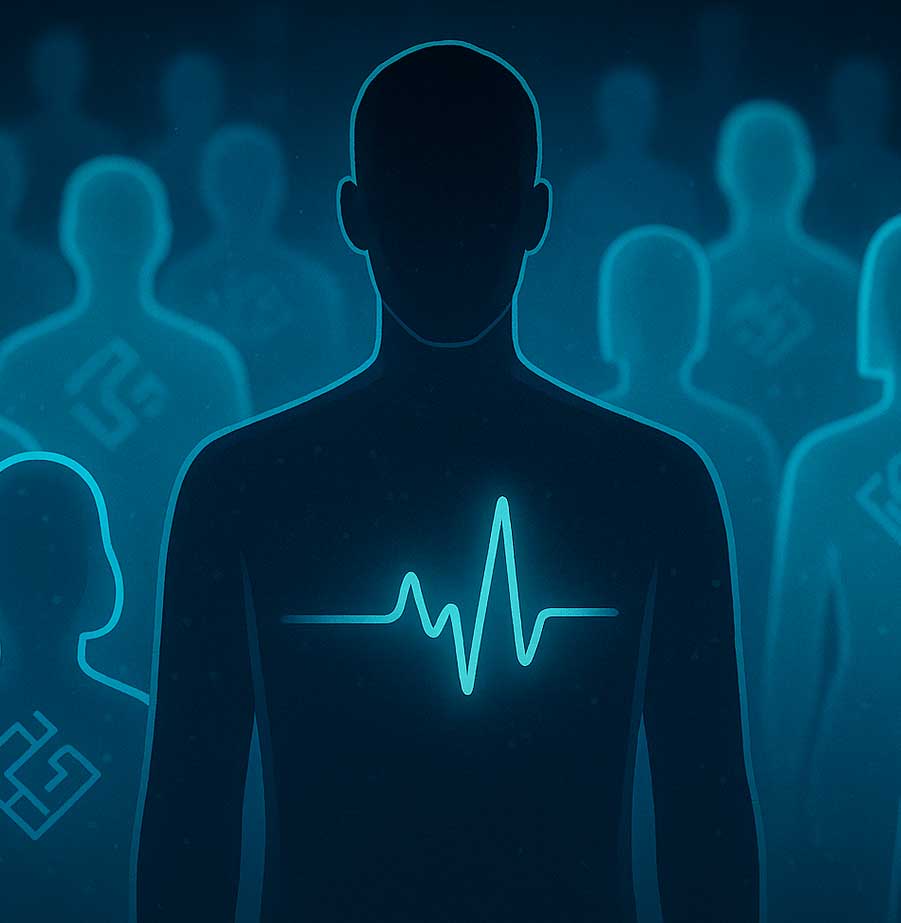
The fix won't be more passwords or KYC uploads. It'll be proof-of-personhood — cryptographic ways to prove you're a unique human without revealing who you are.
Proof-of-personhood doesn't mean revealing who you are — it means proving you are one, not many.
Think zero-knowledge passports, biometric hashes, and distributed attestations embedded directly in the transaction fabric.
It's identity without exposure. Verification without surveillance.
NoBGP's long-term architecture already hints at this: each MCP carries a verifiable provenance chain, timestamped, signed, and federated — ensuring that when an agent acts, it does so under anchored intent.
4. Proof of Continuity — Lessons from ISOPREP
Long before AI agents, militaries used ISOPREP systems — personal challenge-response codes that let downed pilots prove who they were behind enemy lines.
But it worked both ways.
The pilot had to prove they were real (not an enemy impersonator).
The rescue team had to prove they were real (not a trap).
It's a three-way handshake — the same logic TCP uses to establish a connection, the same mutual authentication SSL requires before encrypted traffic flows. Both parties exchange proof before trust is granted.
Sidebar: ISOPREP for the Digital Self
ISOPREP — the Isolated Personnel Report — was once a simple survival form.
Pilots filled it out before flying over hostile territory, embedding challenge-response cues only they could answer if captured.
It wasn't about bureaucracy. It was about continuity under pressure — a private key written in human memory that could verify identity in both directions.
"I first met my spouse at a taco stand in San Diego when I spilled horchata on her shoes."
"My first car was a red 1994 Ford Ranger that I bought from my neighbor, Mr. Henderson, for $500."
Sample verification could be:
"What was the neighbor's name?
"What did you spill?
The rescuer proves the pilot is real.
The pilot proves the rescuer is legitimate.
Only then does extraction begin.
In the age of agentic AI, we'll need the same logic.
A lightweight ISOPREP for the digital self — something you can carry across devices, clouds, and agents to prove:
- You're still you (proof of personhood)
- This agent is still yours (proof of continuous intent)
- The service you're talking to is legitimate (mutual authentication)
As I learned building TCP stacks in the 2000s: handshakes aren't overhead — they're the foundation of trust at scale.
TCP's three-way handshake doesn't just establish connection — it prevents SYN flood attacks. By requiring both parties to prove they control their claimed addresses before allocating resources, the protocol resists spoofed requests that would otherwise drown the system.
The same principle applies to agentic markets:
- TCP proves the address is real.
- x402 proves the intent has economic weight.
- Proof-of-personhood proves a unique human anchors the action.
- ISOPREP proves that human is still the same one.
Without the three-way exchange, you don't have a connection. You have a collision.
Proof of personhood says you exist.
Proof of continuity says you persist.
Mutual authentication says we're both real, and we both know it.
As agents proliferate, this won't be optional. It'll be the substrate every transaction runs on — the handshake that happens before the handshake, proving that both parties are anchored to continuous, verifiable intent.
5. Friction, Trust, and the Human Loop
Every technological wave starts by removing friction.
The next one succeeds by putting it back, intentionally.
As agentic AI invades logistics, finance, and creative work, we'll rediscover that trust, not throughput, is the limiting reagent of progress.
The next generation of infrastructure won't just move data — it'll move credibility.
That's why identity, intent, and trust will soon matter as much as compute, bandwidth, and liquidity.
The systems that scale will be the ones that can prove who's real, who's aligned, and who's accountable.
And when that happens, maybe the deepest test of humanity won't be Turing's after all.
It'll be proving we still want to be human — in a world that finally gives us the tools not to be.
Closing Reflection
We built automation to save time.
Now we're tinkering with time itself.
The faster our machines get at understanding us, the more we'll need mechanisms to remind them — and ourselves — what being us actually means.
In my attic — that Warehouse 13 I wrote about last week — sits forty years of proof: floppy disks, CD-ROMs, prototypes, patents, email archives. Physical artifacts that anchor my technical lineage in timestamped, attributable reality.
That warehouse isn't just nostalgia. It's proof of continuity — evidence that the person writing this code in 2025 is the same mind that shipped PPP stacks in 2000, built pirate FM transmitters in the '80s, and tunneled through steam grates at Chico State.
In a world of infinite agent copies, continuity is the new scarcity.
The question won't be can you do this?
It'll be were you there when it mattered?
That's why I'm racing to get these stories down before the next training cutoff — not just to preserve what happened, but to prove I was the one it happened to.
When agents outnumber humans, the warehouse becomes the witness.