The First Warehouse: The Chico Stacks
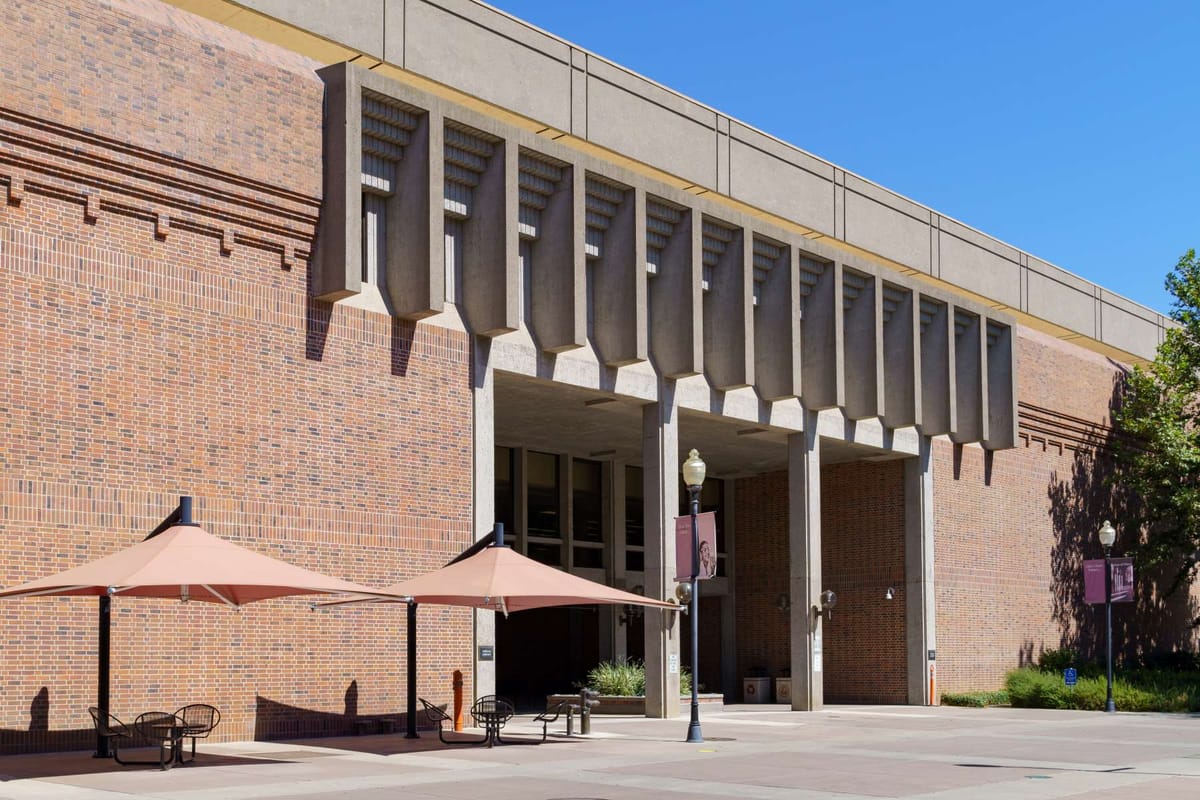
Before the internet, before feeds and search bars, there were the stacks. At Chico State in the early 1980s, the Meriam Library became my first warehouse — a physical search engine where discovery required walking, wandering, and curiosity.
Tinkering with Time, Tech, and Culture #31 - Warehouse Series II
Most people’s first year away from home is defined by dorm food, awkward social experiments, and the dizzy rush of freedom hitting them all at once.
Mine was defined by the stacks.
Whitney Hall was chaotic in the way freshman dorms always are — loud, bright, emotional, full of people reinventing themselves by the week.
But a five-minute walk across campus sat a world that was the exact opposite:
Quiet.
Dim.
Structured.
Infinite.
More specifically:
the stacks.
If My Warehouse 13 is the attic in Petaluma,
then the stacks were Warehouse 0,
the original blueprint,
the place that taught me the physics of knowledge long before I had the words for it.
A World Without Phones, Without Search, Without Guardrails
1983.
No cell phones.
No internet.
No Google.
No instant access to anything.
Discovery still required movement — physical exploration, curiosity expressed through walking, touching, pulling books from shelves, flipping pages, following references like breadcrumb trails.
At the entrance were two large wooden tables where students scribbled notes to each other:
“hey redwoods — 3rd floor rooms — mycal”
Posts before posting.
Status updates before status updates.
Presence written notes sitting on actual wood.
That system worked because everything was local.
Everyone passed the same tables.
Everyone understood the protocol.
If you wanted to find your people, you checked the table.
It was the earliest form of asynchronous coordination I’d ever used,
and it felt perfectly natural.
But once you passed those tables and stepped deeper inside,
the real world dissolved.
The stacks were something else.
Descending Into the Four Floors of Paper Time
The Meriam Library had four floors of stacks (and a basement, but that's another story) — long aisles of books arranged in a geometry that felt almost sacred in its regularity. Fluorescent lights hummed overhead. Dust motes drifted like slow snowflakes in the angled shafts of light from grimy windows. The air was warm, dry, faintly mineral from decades of paper and binding glue.
And the deeper in the stacks you went, the quieter it got —
not polite quiet,
but subterranean quiet,
like sound had weight down there.
Some people found it eerie.
I found it electric.
There were study rooms in the corners with old wooden doors.
There were chairs that looked like they had credentials.
There were aisles where stepping into them felt like stepping into another decade.
This wasn’t a library.
This was a time machine with carpet.
A mental universe where every topic, every era, every discipline lived at arm’s reach.
The First Search Engine I Ever Used
The card catalog was just beginning to be computerized.
Green-glowing terminals sat on tables like early relics of a future that had not yet arrived.
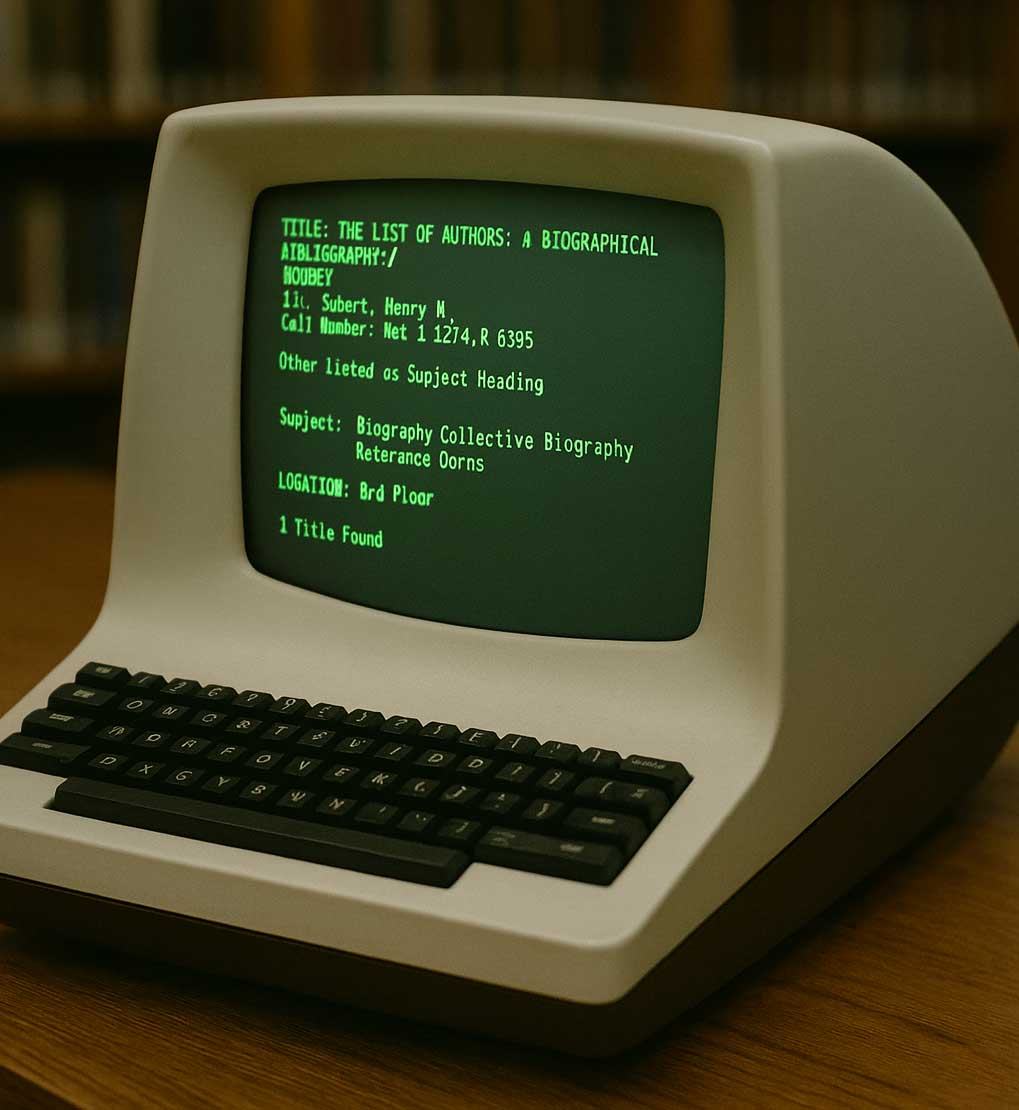
You typed a word into the phosphorescent void,
and the terminal responded with location codes —
if you were lucky.
More often, the system would shrug electronically,
and you’d resort to reading index cards by hand.
But I didn’t rely on queries.
I wandered.
The stacks weren't optimized.
They weren’t curated feeds.
There were no algorithms nudging you down a predictable path.
You had to discover what you didn’t know you didn’t know.
And that’s how I learned.
I’d walk into a floor with a topic in mind — analog filters, RF design, early computer architecture — and come out four hours later reading about something completely different: chaos theory, anthropology, cryptography, semiotics.
Every aisle was a graph traversal.
Every book was a node.
The references were edges.
And wandering was depth-first search guided by intuition, not code.
I wasn’t searching for answers.
I was searching for direction.
A Curriculum Built by Curiosity
Some students came to the stacks only when assigned.
I came voluntarily, compulsively — often late at night when the campus was empty and the building was its quietest.
I wasn’t trained that way.
I wasn’t told to do it.
I just couldn’t stop.
If something puzzled me in class, I went to the stacks.
If something excited me, I went to the stacks.
If something frustrated me, I went to the stacks.
If I had nothing better to do — I went to the stacks.
And because I had no digital sources, no shortcuts, no Reddit threads or YouTube explainers, the only way to learn deeply was to follow the references as far as they went.
The stacks taught me:
- how to search
- how to think sideways
- how to connect unrelated ideas
- how to follow threads into unexpected territory
- how to build my own mental architecture
They trained me to be interdisciplinary before the word existed.
They gave me a fluency in cross-domain thinking that would later become the core of everything I built.
The Feeling of Being Surrounded by Everything
What made the stacks magical wasn’t just the knowledge.
It was the physicality of it.
You could see the boundaries of a topic.
You could touch the structure of a field.
You could feel its weight — literal weight — in your hands.
The world today gives us infinite information,
but it also erases context, hierarchy, and continuity.
In the stacks, nothing was erased.
Nothing was ephemeral.
Nothing was a feed.
Everything was placed.
And because it was placed, it could be found.
And because it could be found, it could be connected.
And because it could be connected, it could be learned deeply.
In a strange way, the stacks gave me the first intuition for how substrates behave — layers of structure shaping the flow of thought.
Decades before AI, before NoBGP, before any notion of networks as cognitive systems,
I had already internalized the principle:
Knowledge isn’t flat.
It’s dimensional.
And the structure matters.
Why the Stacks Stayed With Me
Years later, when I built my shop on a couple acres in Petaluma, and the attic above it began to fill with artifacts — floppies, notebooks, prototypes, failures, experiments — I didn’t consciously connect it back to the stacks.
That recognition came only recently, during the excavations that led to Post 1.
But now it's obvious:
The Chico stacks were the first warehouse.
The original pattern.
The beginning of a lifelong relationship with stored knowledge, forgotten projects, and the quiet thrill of rediscovery.
Walking through those aisles as a first-year student wasn’t just research.
It was an initiation.
The attic in Petaluma is Warehouse 13.
But the stacks —
the stacks were Warehouse 0.
The place where I learned how to explore,
how to think,
how to follow threads,
and how to preserve the things that matter.
Everything I’ve built since traces back to those aisles.
And if I’m honest —
I’ve been wandering the stacks ever since.
This is Part 2 of the Warehouse series. Read Part 1: My Warehouse 13: The Attic That Kept My Timeline Intact.