
Access Isn't Ability
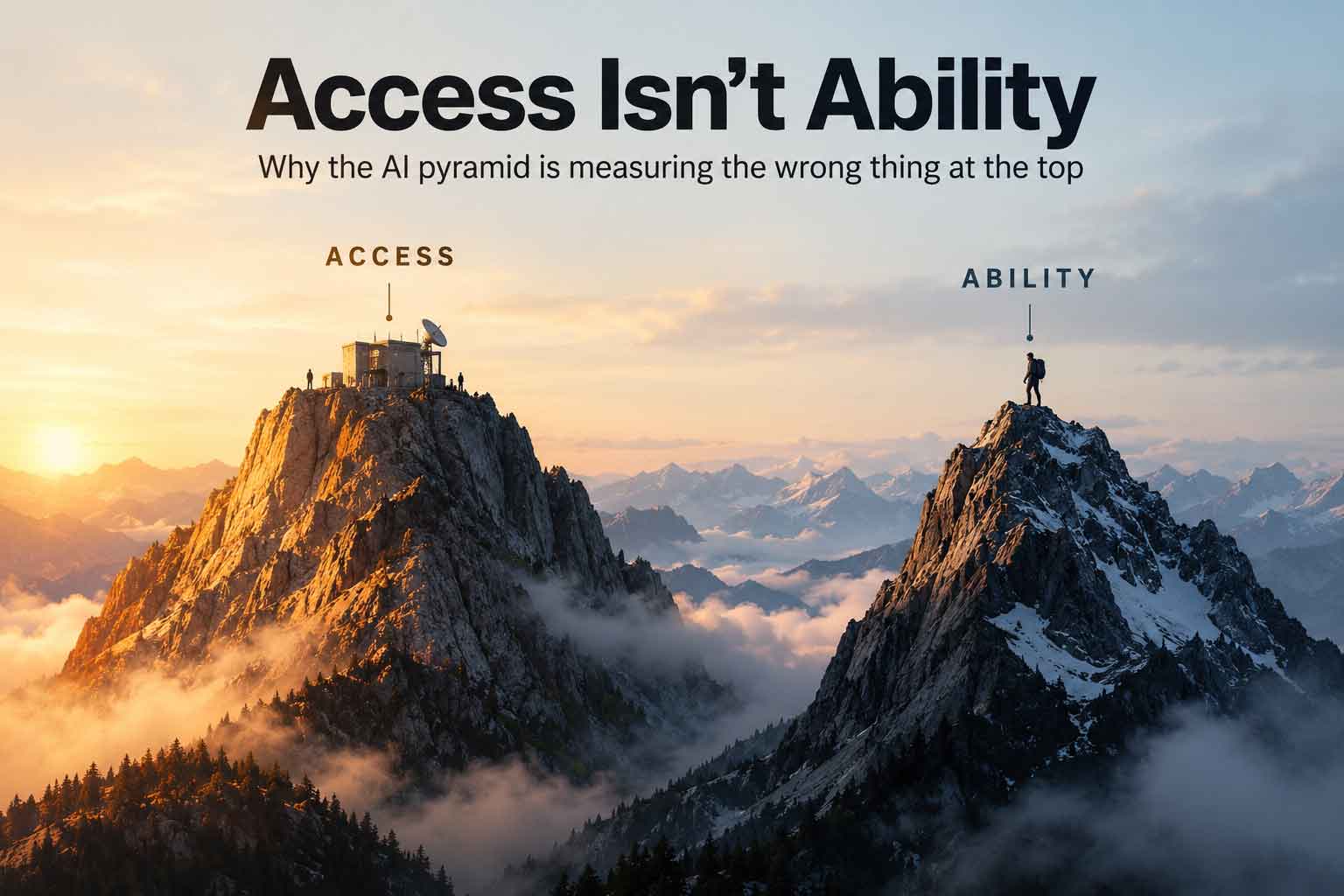
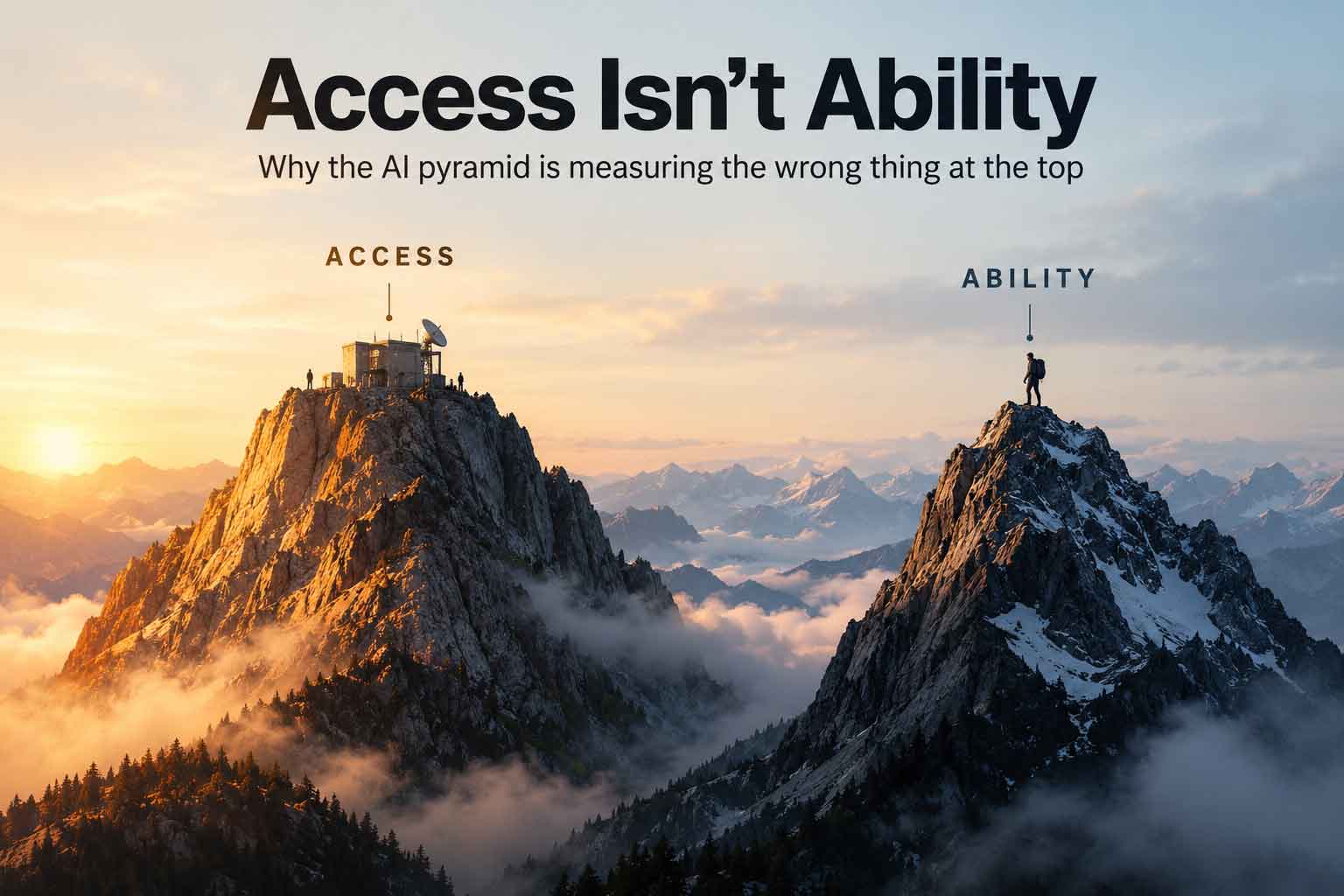
AI access and AI ability aren't the same thing. The real measure is leverage with verification: how much competent work you can hand off and still trust.
Tinkering with Time, Tech, and Culture #64
Why the AI pyramid is measuring the wrong thing at the top
We like to talk about AI users in pyramids. There's the 1%, the people who actually use these tools seriously. Then the 1% of the 1%. Then the 1% of that, and somewhere near the point of the pyramid sit the few thousand people, call it 5,000, with access to what the foundation labs haven't released yet.
It's a satisfying picture, and the math even works. Start with roughly 8 billion people:
- 1% is about 80 million
- 1% of that is about 800,000
- 1% of that is about 8,000
That last number lands intriguingly close to my rough estimate of the frontier-access crowd. Neat. The log-scale tiers also fit how this actually works: AI leverage is far more skewed than a bell curve. A small number of people get wildly more out of these tools than everyone else, so powers of 100 are the right shape.
The shape is fine. The problem is what changes as you go down it.
The pyramid switches rulers halfway down
Every tier of the pyramid measures how well you use AI, until the last one. The last one measures who let you in.
Access to unreleased models is a gate, not an ability. Plenty of people inside the labs use their own models the way most people use a search box. Plenty of people outside the labs, on the same public models anyone can pay twenty bucks a month for, are getting results that would surprise the people who trained them.
When we put "frontier access" at the top of a skill pyramid, we're quietly treating position as if it were proficiency. It's the same mistake as assuming the people with keys to the datacenter are the best programmers in the building.
Access isn't ability. Leverage with verification is ability. The rest of this post is about what that means.
Two axes, not one pyramid
The fix is to split the pyramid in two.
Axis one is access. It's a gate with a few doors: free consumer tools, paid tiers and APIs, enterprise and early access, and frontier/unreleased. You don't earn your way through most of these doors by being good. You get through by being employed, invited, or paying.
Axis two is ability. Keep the same pyramid and the same powers of 100. Just change what's being measured, and rank people by what they can hand off and still trust. These aren't survey-derived population estimates; they're orders-of-magnitude tiers:
| Tier | ~People | What it looks like |
|---|---|---|
| Everyone else | billions | Asks questions, accepts the answers |
| The 1% | ~80 million | Iterates and engineers context: drafts, pushes back, notices when it's wrong, gives the model the right files and constraints so it starts informed |
| 1% of the 1% | ~800,000 | Agentic, and increasingly multi-agent: models with tools acting on real systems, often several running in parallel on multistep work |
| 1% of that | ~8,000 | Builds the systems agents live in: the infrastructure, protocols, and harnesses agents run on (often other people's agents too), persistent agent systems that coordinate with each other and with real machines, and verification built into the system instead of done by hand. Unattended work stays bounded, observable, and reversible by design |
Look at the bottom row. It's the same size as the frontier-access crowd: a few thousand people. It's just not the same people. That's the whole point. Two groups of roughly equal size sit at the tips of two different pyramids. They overlap, but nowhere near completely.
Each step down is a step change in leverage. Each one is also a step up in how much damage you can do if you don't know what you're doing. Hand a model a shell and it can fix your build or wipe your home directory. The ladder isn't just about doing more. It's about being able to afford to let it do more.
That's why the bottom tier isn't defined by trust. Trusting unattended work blindly is a beginner's mistake at scale. The skill is building systems where you don't have to trust: work that runs on its own but stays inside limits, leaves a trail, and can be undone.
The most interesting square on the two-axis grid is the one the pyramid hides: high ability, ordinary access. Those are people whose edge is pure skill, with nothing handed to them.
The metric: leverage with verification
If you want one number for the ability axis, here's mine:
Hours of competent output per hour of your attention, discounted by the errors that get past you.
The second half is the part everybody skips. Running twenty agents is impressive until you learn that nobody checked what they did. Someone running three agents and catching every mistake is ahead of someone running twenty and catching none. Volume without verification isn't leverage. It's a liability you haven't found yet.
This is also why prompt cleverness doesn't rank very high on my ladder. Clever prompts are a technique. Knowing when the output is wrong is a capability.
The tiers keep sinking
Here's the uncomfortable part for anyone who thinks they're in the rare tiers: the floor keeps rising underneath you.
What counted as 1-in-a-million practice eighteen months ago, like giving a model tools and letting it run multistep tasks, is now a product feature with an onboarding screen. Things that took custom plumbing ship as checkboxes. The techniques migrate up the pyramid toward the masses, which is exactly what should happen.
It's already happening one tier down: running several agents at once was rare not long ago, and now it's routine for a big slice of the 1% of the 1%. The rarest tier isn't defined by how many agents someone runs. It's defined by whether they're building the ground those agents stand on.
So tiers can't be defined by specific techniques. "Uses agents" isn't a tier; it's a timestamp. A tier has to be defined relative to what's available: are you doing what the tools now make easy, or what they're just about to make possible?
Domain depth is the multiplier
The last piece is the one most AI rankings leave out entirely: what you knew before the model showed up.
A great AI user with no domain expertise has a ceiling, because they can't judge the output. The model is fluent about everything, and fluency is the most convincing form of being wrong.
I've been writing networking code since 1984. When a model hands me a TCP state machine or a tunnel configuration, I know within a few lines whether it's right, plausible-but-wrong, or confidently inventing things. That isn't AI skill. It's more than forty years of scar tissue. But it's what makes the AI skill worth anything, because it's what lets me hand off more and verify faster.
The people in the rarest tier of the ability pyramid are almost never "AI people" first. They're experts at something else who've learned to multiply it.
So who's actually at the top?
Not necessarily the 5,000 with early access. Some of them, sure. Access plus ability is a powerful combination, and the labs hire some genuinely excellent people.
But the real elite tier isn't "has the best model." It's high ability under ordinary access: people who create extraordinary leverage from tools everyone else can already reach. They hand off more than you'd think is safe, and they're right to, because they've built the guardrails and they catch the errors you'd miss.
Access moves quickly. Models commoditize. Features spread.
Judgment doesn't.