
Standing By The Record Machine - Chapter Six
At a Contra Costa substation, Ray finds a waveform electricity shouldn't be able to make. Then the State of California emails him.
Tinkering with Time, Tech, and Culture #63
Contra Costa County, February 2026
The substation sat behind three fences at the end of a road that didn't want you on it, humming to itself the way substations do, a low sixty-cycle note you felt in your teeth before you heard it. Ray liked the sound. It was honest. Everything a substation did, it did out loud.
The manager's name was Okonkwo and he had the look Ray had come to know, the look of a man who had stopped being embarrassed and started being tired. He met Ray at the gate with a hard hat and a visitor badge and a folder, and he did not say a word about 5G, which was how Ray knew this one might be real.
"You read my email," Okonkwo said.
"The recording your consultant says can't be right."
"He's a good man. He's not wrong that it can't be right." Okonkwo handed over the folder. "I'd just like to know what it is anyway."
They walked the yard while Ray got the shape of it. The event came in the afternoons, roughly, not on a clock. The protection relays, the fast digital ones that watched the lines and tripped the breakers if a fault went by, had started seeing faults that weren't there. Not glitches. Faults. Clean signatures of a real short somewhere on the line, except there was no short. The line was fine; the crews walked it twice.
Twice they'd let the relays do their job and dropped power to a third of Brentwood over a fault that did not exist. Now they ran the relays in a supervised mode, a human in the loop second-guessing the machine, which was expensive and which everyone hated, because the machine was supposed to be the thing you trusted.
"That's the part that gets me," Okonkwo said. "These relays. We trust them with the grid. They don't imagine things. That's the whole reason we buy them."
"They don't," Ray said. "They record what they see. Seeing and being right aren't the same job."
He set up in the control house where the relay data lived and he pulled the recording, and for a long minute he forgot Okonkwo was standing there.
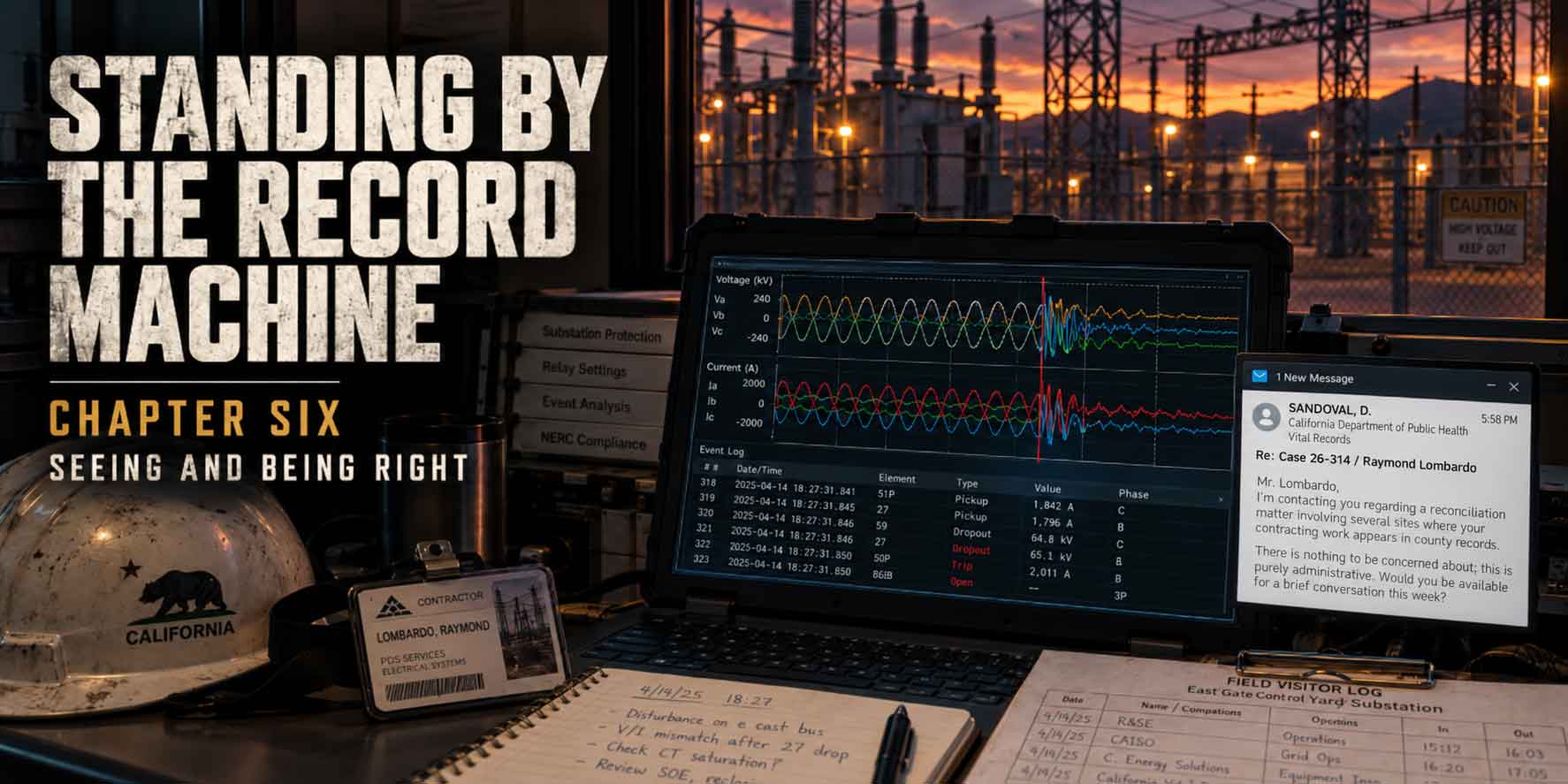
A protection relay captures the moment. When it thinks it sees a fault it freezes a little window of time around it, the current and voltage on every phase, sampled thousands of times a second, the raw waveform. It is the closest thing the electrical world has to a photograph. And the photograph showed a fault: current climbing where it shouldn't, the waveform folding exactly the way a real short folds. Then, mid-event, for a span of samples Ray counted twice because he didn't believe the first count, the current went one way and the voltage did not follow.
That doesn't happen. Current and voltage argue, they lag, they lead, but they are married, they are the same event seen two ways, and here for a slice of a second they had filed for divorce. The relay had recorded electricity doing a thing electricity does not do, in high resolution, with a timestamp, and then recorded it stopping, and the line reading nominal on the far side like nothing had occurred.
Ray knew every mundane way a recording could lie. He'd built a life on them. Sample clock drift in the heat. Front-end saturation. A ground loop putting a ghost on the reference. A failing capacitor in the relay's own supply throwing hash into the sampler. He started down the list the way he always did, calm, methodical, because the list was long and one of its branches was almost always the answer.
He was three branches in when the feeling arrived, cold and clean at the base of his skull. He knew this waveform. Not this one. This kind. He had three of them in the closed directory, from three different years.
Four. This made four.
"Mr. Lombardo?"
"Give me the maintenance logs," Ray said, and his voice was fine, his voice was always fine. "Everything you've changed on this station in the last year. Relays, firmware, the supplies, the wiring, the lights, the coffee maker. And I'll want to be here in the afternoon when it happens, not looking at a picture of it."
The three in the directory were all pictures, recordings handed to him after the fact. He had never once been standing in the room, instrument live, when the thing itself came through. This time it would resolve into some beautiful stupid mundane thing, a bad cap or a hot clock, and he'd go home lighter than he'd come, or it wouldn't, and he'd have a fourth picture, better than the other three, taken with his own hands.
He wanted the first one. He told himself he wanted the first one. He was fifty-three and he had spent his whole life preferring to be wrong about things he could put a probe on, and he did not examine too closely why his pulse had picked up, or why, driving home in the dark with the substation's hum still in his teeth, he found himself thinking about a tin in a drawer he hadn't opened since a woman named Lynn still lived in the house.
The email was waiting when he got in.
Not from Okonkwo. From the State of California, Department of Public Health, Vital Records, a name he didn't know, Sandoval, D., subject line just a case number and his own name. Polite. Brief. A reconciliation matter regarding several sites where his contracting work appeared in county records, nothing to be concerned about, purely administrative, could he make himself available for a brief conversation this week.
Ray read it twice. Reconciliation. A records word, from a stranger, attached to his own name and several sites.
He wrote back that Thursday was bad. He'd be at the substation.
Friday, then.
Chapter five - Chapter Seven