
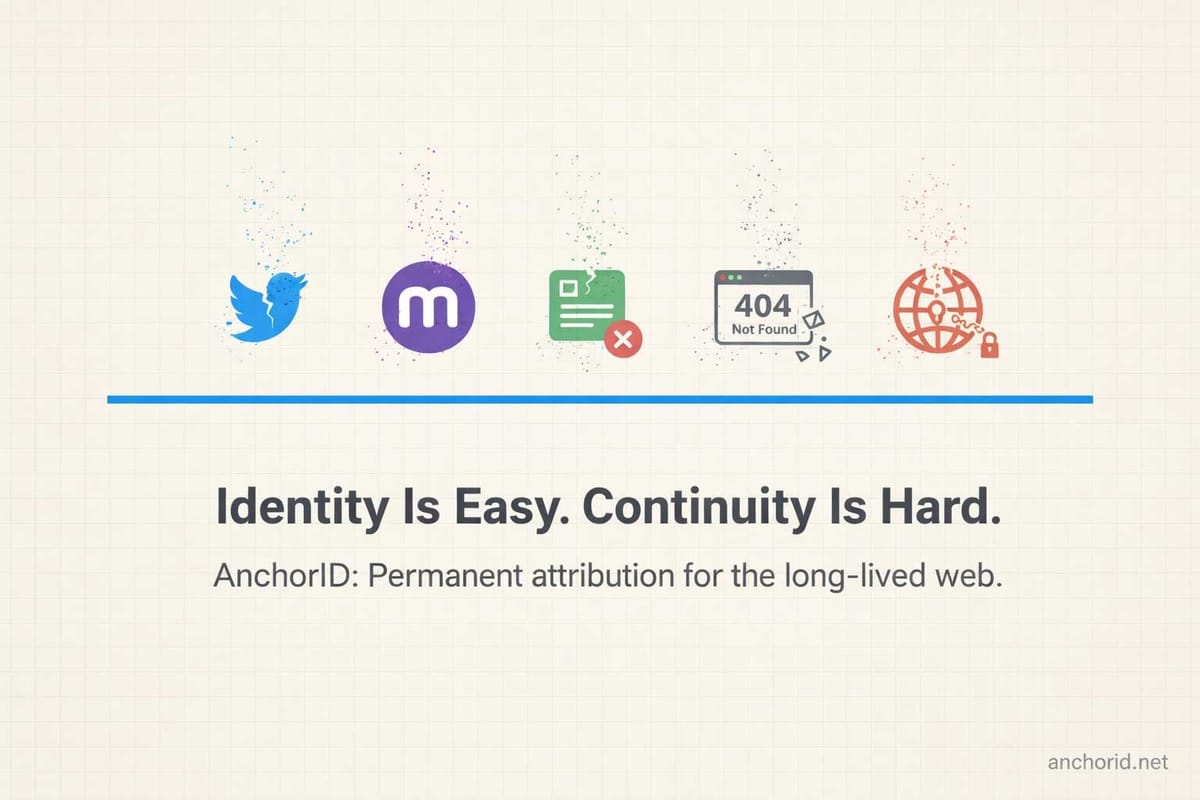
Identity Is Easy. Continuity Is Hard.
Most identity systems fail over time. AnchorID is a deliberately boring attribution anchor designed to preserve continuity across platforms, archives, and AI systems.
Tinkering with Time, Tech, and Culture #38
Most identity systems fail not because they lack features, but because they assume the world will cooperate with them.
They assume platforms will remain stable.
They assume registries will be funded forever.
They assume cryptographic schemes will stay fashionable.
They assume users will rotate keys, migrate wallets, or care enough to keep up.
History suggests otherwise.
The Real Problem
The hardest part of identity is not authentication, reputation, or verification.
It is continuity over time.
Names change. Domains expire. Companies disappear. Blockchains fork. Social networks collapse, rebrand, or get abandoned. Even well-intentioned systems accumulate technical debt, governance risk, and incentive drift.
Most identity projects optimize for now:
- fast onboarding
- strong cryptography
- elegant protocols
- impressive diagrams
Very few optimize for still working in 20 or 50 years.
Over the last year, I’ve been working and experimenting with ways to address that gap. AnchorID is the answer I arrived at.
What AnchorID Is
AnchorID is a deliberately small attribution anchor.
At its core, it consists of:
- a stable UUID
- a permanent HTTPS resolver URL
- a minimal, public, inspectable JSON-LD document
The goal is not to own identity, but to provide a stable reference point that other systems — present or future — can point at without fear that the meaning will drift.
AnchorID is designed to be understood by systems that do not know or care about AnchorID specifically. If a future system can fetch a URL and parse JSON, it can understand an AnchorID record.
That property is rare — and intentional.
What AnchorID Is Not
AnchorID is not:
- an authentication system or login provider
- a reputation or scoring system
- a replacement for OAuth, DIDs, or wallets
- an authority that grants identity
AnchorID does not prevent false claims.
It does not adjudicate truth.
Instead, it answers a simpler question:
Can this person or organization demonstrate continuity across independent systems?
A website proves control of a domain.
A GitHub README proves control of a developer identity.
A public profile proves continuity over time.
Nothing is hidden. Nothing is implied. Consumers decide how much trust to assign.
Why Boring Is the Point
AnchorID is built from deliberately unexciting components: UUIDs, HTTPS URLs, plain JSON, and schema.org vocabularies.
These are not cutting-edge technologies. That is the point.
They are widely implemented, deeply archived, and extremely likely to remain interpretable long after today’s identity stacks are forgotten. AnchorID avoids new URI schemes, new resolution layers, and new cryptographic ceremonies.
It uses the web as it already exists.
In practice, this makes AnchorID easy to mirror, archive, and re-host — including by people who have never heard of the project.
That is a feature, not a limitation.
Auditability Over Convenience
AnchorID is designed to be understandable by humans, machines, and archivists alike.
If an identity claim cannot be explained by pointing at a URL and saying “look, this is what it says,” it is not a strong claim.
This bias toward auditability trades off convenience, but it dramatically improves long-term reliability.
Designed to Outlive Its Creator
AnchorID assumes it will someday be abandoned.
That is not pessimism — it is engineering.
A good identity system should leave behind artifacts that remain useful even if the original operator disappears, the code is no longer maintained, or the documentation is lost.
If all that remains is a UUID, a URL, and a JSON document, AnchorID has succeeded.
Why Now
As more of our cognition, memory, and attribution are mediated by machines, the cost of identity collapse increases.
When AI systems ingest the world’s data, they often compress variant human context into a single point. Distinct authors, projects, or artifacts can be incorrectly merged because their attribution trails were fragmented or ambiguous.
AnchorID is designed to act as a stable, high-signal reference point in that environment — making continuity explicit where it would otherwise be inferred or lost.
The Project
AnchorID is open source.
The reference implementation, documentation, and philosophy are public.
AnchorID is not trying to be the center of identity.
It is trying to be something other systems can point at — quietly, reliably, and for a long time.