
Standing By The Record Machine - Chapter Four
Oakland, 1995. Ray and the Group of Four burn a web archive onto CD-ROM, freezing what they know before it can disappear. Then an old man gives Ray something to take and asks him to pay attention.
Tinkering with Time, Tech, and Culture #60
Oakland, December 1995
They burned the master at two in the morning on the second of December, clean, nothing on it but the archive, because the master went out in the mail to the duplication house, and the duplication house was not your diary.
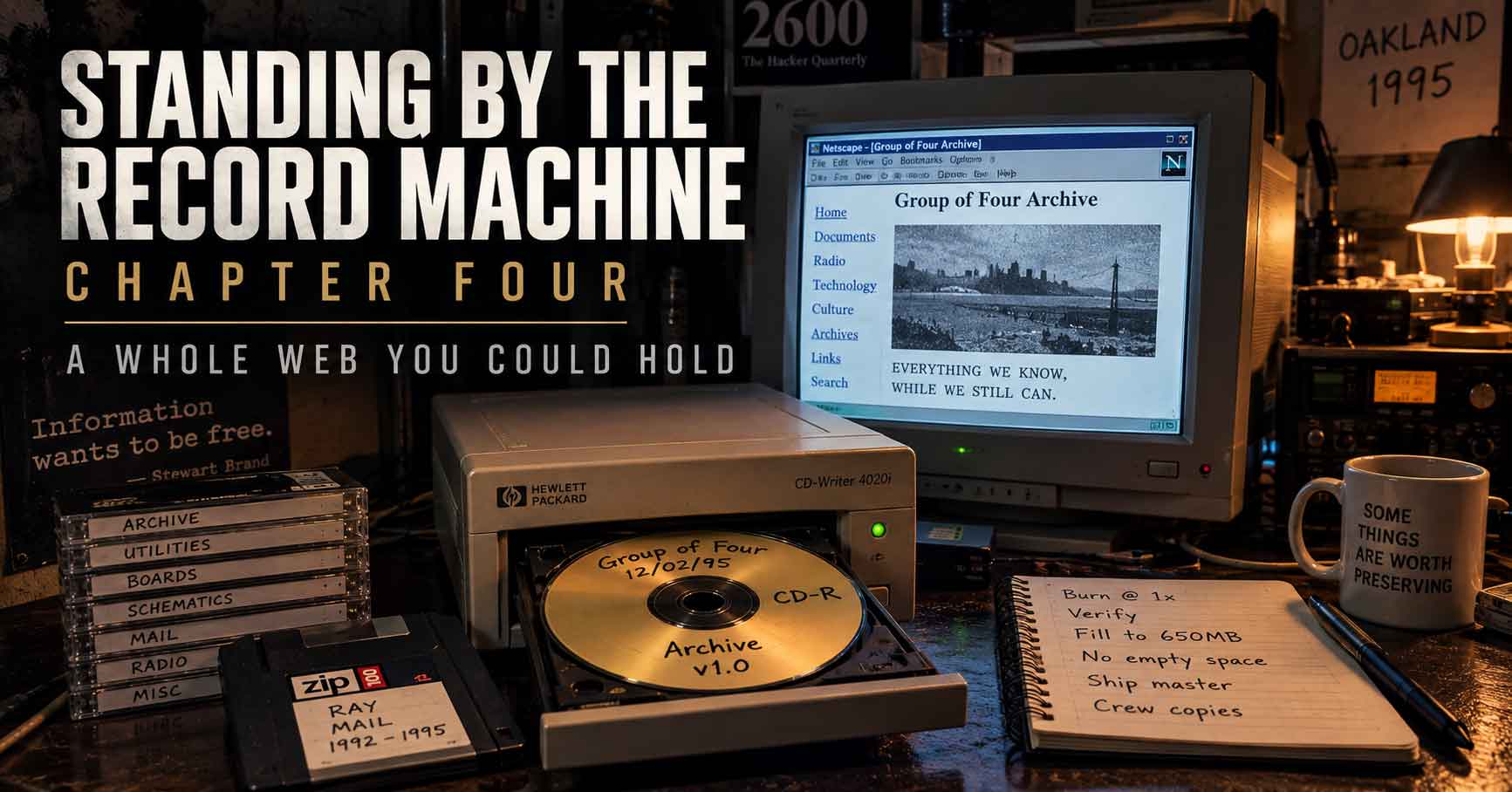
The burner was Deke's, an HP 4020i that had cost about a grand and made him insufferable, because two years earlier the same trick took a ten-thousand-dollar SCSI deck and a prayer. It wrote at 2× write speed, but Deke ran masters at 1× to dodge buffer underruns, which cut the failures from one disc in five to one in ten, and they fed it gold blanks like an offering and did not walk heavily anywhere near the table while it worked.
Copies were another matter. Production you sent out; copies for the crew you burned by hand at the full 2×, coasters be damned, five or ten at a sitting, one disc at a time in the tray, and the tray charged by the meg. The archive, all of it, every file the four of them had spent a year pulling together and marking up and arguing about, came to a little under four hundred megs, which wrote in about twenty-five minutes and left a quarter gig of blank. A full disc took the whole forty. Which meant filling the empty space cost you fifteen minutes a copy, and they paid it, every single time, because a disc with two hundred and fifty megs of nothing on it offended Deke personally.
"You don't ship empty space," Deke said. "It's rude."
So the crew burns got filler, each one a little different, whatever was lying around the machine that night. Somebody's cracked utilities. A mirror of a phreak board that was already dead and would be forgotten by summer. A run of scanned schematics. And Ray, when his own copy went into the tray, topped it off with his mail, three years of it brought on a Zip disk, in two layers, because it had been two lives. The Eudora mailboxes hauled straight off his machine, from the time since he'd gotten a SLIP tunnel running and taught a Windows 3.1 box to speak TCP through Trumpet Winsock, and under those, older and shaped differently, the mail from his first year online, 1993, a shell account at CRL he'd read with pine over a 14.4 while the phone line was tied up and his mother wondered aloud who he was talking to, the whole home directory pulled down off the shell and kept. It was his disc and the alternative was zeros.
Nobody read it. That was understood. You didn't read a man's mail, you just kept it from being nothing, and anyway it was mostly list traffic, radio arguments, crypto arguments, the same forty people being right at each other across three years. Provenance, Deke called it, grinning, because Deke had a word for everything and liked the ones that made a pile of old email sound like a cathedral.
The thing that made it theirs, the thing Deke would not shut up about, was that you browsed it. Clark had built the whole archive in HTML, every file linked to every other file, pages inside pages, and you put the disc in a machine and it came up like a little world you could walk around in. Click a word, land somewhere new. Back, forward, home. In 1995 almost nobody had the actual web, not really, not at home, not fast. But you could have this. The internet, or the good parts, the parts worth keeping, frozen on a disc and handed to you for thirty dollars, and it worked the same on day one as it would on day ten thousand because nothing on it could change. That was Clark's word for it. Frozen. He said it like a promise. Deke said it like a boast, first ever, nobody's done this, and maybe nobody had, and it didn't matter, because who was going to check.
Ray thought about it more than he let on. A whole web you could hold. It said the same thing every time you asked. He didn't have language yet for why that mattered to him. He just knew he trusted a thing that couldn't change its answer.
The disc had a name. They'd argued about it for a month and landed on the joke, because it was 1995 and everyone they respected was either getting a mortgage or getting indicted, and the joke was the only honest thing left to call it. Everything We Know, While We Still Can. Underneath, smaller, the part that was really the title: GROUP OF 4 · SELLING OUT.
The crew didn't have a name, exactly. Over the past few years a couple of write-ups in 2600 had run signed the Group of Four, because there were four of them and nobody could be bothered to invent anything better, and the name had the advantage of dissolving on contact: every crew was a group of something. Four guys who wrote things down. It barely counted as a fingerprint, which, Deke said, was the whole idea. Then the name stuck anyway. People at meetups knew them by it, asked after it, wore it smooth with use, and so it went on the disc under the real title, because by then the non-name was the name. Anonymity, it turned out, was a thing other people decided for you. Nobody said that part out loud.
That was the bit, the whole bit. Four guys, some of whom had spent a decade telling the world that information wanted to be free, had finally packaged it up and priced it at thirty dollars, and they were the first to say so, loudly, on the disc itself, before anyone else could. You could not embarrass a man who had already embarrassed himself on purpose. It was the same armor Kellaway wore. Get out ahead of the joke and nobody else gets to make it.
Ray was the youngest by six years and the only one without a degree, and neither of those had ever come up, because the group was built on the one thing that didn't care about either. Could you do the work. He could do the work. He'd been doing it since Kellaway walked him into his first meeting at nineteen and the room ran quiet for a second the way rooms do when the new guy is younger than the equipment.
Three years on, nobody ran quiet. He was just Ray. He fixed what broke, built what was needed, and the group let him hang his own mail in the empty space of his copy like a kid taping a drawing to the family fridge. He'd have told you it meant nothing. He kept that burn anyway, the personal one, cut the night before the master with the first of December in marker on its face, archive plus mail, the one that was really his, in the black zippered CD wallet with the others, and didn't think about why.
Deke mailed the master to a duplication outfit up in Washington state that asked no questions, because Deke had burned it and Deke did not let a master out of his own hands until the post office had it, and two weeks later two hundred copies came back in plain white sleeves, machine-duplicated onto blanks like their own, the title silkscreened clean on every face, no jewel case, no insert, because cases cost money and the packaging was part of the joke. The master and the four personal burns stayed gold, hand-labeled in marker, the only five discs in the world the machine hadn't touched. Sold most of them by mail order out of a PO box. Made almost no money, which was fine, which was the point, which was the joke again. And that would have been the whole of it, one more disc in a decade of them, except for what happened the Saturday before Christmas.
The old man's name had been in the papers the year before.
Not the front, the back, the kind of item you only saw if you already knew who he was. The government had come for his lab a year ago that fall, taken his license, taken his samples, handed him a fine with a number on it that was meant to sting a man who had spent his life not caring about numbers. Everyone in the scene had an opinion, and a year had not settled one of them. Half of them thought he'd been reckless. The other half thought he'd been brave. Nobody thought it was nothing, and nobody could say exactly what it was, which was about right for the old man, who had spent forty years being difficult to categorize on purpose.
Ray had met him twice more since the party in the hills, both times by accident, both times the same. The old man would find him at the edge of some gathering, ask him something specific and strange, listen to the answer like it mattered, and drift off before Ray understood what the question had been about. Ray had stopped trying to make it add up. Some people were weather. You didn't ask the fog what it wanted.
At a Christmas thing in the Oakland hills, on the twenty-third, three weeks after the burn, the old man found him again. The loud shirt was the same, but the year had taken something out of the man inside it, the way a signal loses a few dB and you can't point to where.
"The transmitter man," he said. "Still building?"
"Always."
"Good." He had a paper cup of wine this time, cheaper venue, same untouched. "Take something for me." And he put a small tin in Ray's hand, the kind lozenges came in, and closed Ray's fingers over it with both of his own. "Not tonight. When you're working. When you're calm and the room is quiet and you're paying close attention to something. Then take one, and tell me what you notice."
"Notice about what?"
"That is the question, isn't it." He was already turning. "You'll write it down. You write everything down. I have always liked that about you." And then, over his shoulder, in a voice Ray almost missed under the party: "You may be the only honest instrument I have left."
Ray put the tin in his jacket and forgot about it through Christmas, because he was twenty-two and a strange old chemist handing you a mystery tin was, in that scene, in those years, a Tuesday.
He remembered it on the Thursday after Christmas, the twenty-eighth, alone in the second bedroom of the place off Tennessee Street, at the bench, at midnight, tuning the new rig.
It was a good build. A little half-watt thing, clean, the kind of clean he could feel before the meter confirmed it. He had the disc on the bench beside him, his own copy, playing nothing, just there, because he'd been showing somebody the archive earlier and hadn't put it away. He had the tin open. He'd taken one an hour ago, the way the old man said, when the room was quiet and he was paying attention, and so far he had noticed nothing except that he was, in fact, paying very close attention, which he suspected was the whole trick, the old man selling him a sugar pill and a good habit in one tin.
He was leaning over the rig with the probe on the final stage when the room went wrong.
Not dark. Not loud. Wrong in a way he had no meter for. The transmitter, which was drawing power, which the supply said was drawing power, went silent on the analyzer for a span of time he could not afterward pin down, three seconds, nine, he'd argue both with himself for years. The trace flatlined and the current didn't. That was impossible and he knew it was impossible while it was happening, a cold clean certainty at the base of the skull, the same feeling as the party in the hills, the room doing arithmetic it didn't want to do, except this time the room was him.
Then it passed.
The trace stood back up. The rig sang like it had never stopped. The supply read what it had read. Ray sat very still with the probe in his hand and his heart going and waited for the world to finish whatever it was doing, and the world declined to tell him it had done anything at all. The bench was the bench. The disc was on the bench. The tin was open. Midnight, Tennessee Street, a good clean half-watt build.
He wrote it down, because he wrote everything down. Anomalous dropout, final stage, ~mid-cal. Trace null, supply nominal. Cannot reconcile. Possible: probe fault, supply telemetry lag, operator. He looked at that last word a while. Operator. Then he wrote, because he was honest even in his own notebook where no one would ever grade it: Felt wrong. Note: took AP compound 60 min prior. Discard.
He almost called the old man. It was late. He didn't.
The next morning everything was exactly where it should be and he decided the way you decide these things at twenty-two, which is by having a transmitter due and rent to make, even at his mother's rates. Probe fault. Had to be. He checked the probe and the probe was fine, which told him nothing, because a fine probe was consistent with a probe that had faulted once at midnight and recovered, and it was also consistent with the other thing, the thing he was not going to write down again, and between those two he chose the one he could put back in the drawer.
He kept the disc in the black wallet with the others.
He saw the old man exactly once more, in January.
The tin went in a drawer. The note stayed in the log, where Ray kept the past he trusted, filed under a Thursday in December, true and complete and boring on purpose.
Chapter Three - Chapter Five