
Standing By The Record Machine - Chapter Three
Ray Lombardo has spent thirty-one years measuring things people misunderstand. Then a job arrives with a recording that can't be right—and a question he can't ignore.
Tinkering with Time, Tech, and Culture #58
Chapter Three
Standing by the Record Machine
Vallejo, February 2026
The hospital had been losing heartbeats every afternoon for three weeks.
Not the patients. The telemetry. Forty beds on the fourth floor wore wireless monitors that reported to the nurses' station, and every day between about two and five the reports came apart. Dropouts. Gaps. A heart that looked stopped for nine seconds and then wasn't. The nurses had learned to jiggle the receivers, which did nothing, and to apologize to the day shift, which also did nothing but felt better. The hospital's IT department had replaced the access points twice. The vendor had flown a man up from San Diego who ran a diagnostic, declared the system healthy, and flown home.
So now, at the end of the food chain, where these things always washed up, they had called Ray.
He liked hospitals, in the way he liked any building with good bones and honest problems. He did not like the man from facilities who met him at the loading dock, a young supervisor named Braden with a lanyard and a theory. Braden had done some research online. Braden believed the problem was the new 5G installation on the parking structure across the street, and Braden shared this belief in the elevator, in the corridor, and twice more while Ray was unpacking the spectrum analyzer, each time with the special confidence of a man who has read three articles. The third article, offered in the corridor as a kind of credential, was about a company in Mountain View that had built a chip which did its computing, the company's own man had written, in parallel universes. Braden said this as if it settled something. Ray put it where he put the tower.
Twenty years ago Ray would have taken the theory apart in front of him, bolt by bolt, and enjoyed it. The demolition never took. You could show a man the spectrum and he'd keep the tower. People held their explanations the way they held their memories: warm, close, label side out.
"Could be," Ray said. "Let's measure."
Measuring is the whole job. Everything else is opinion.
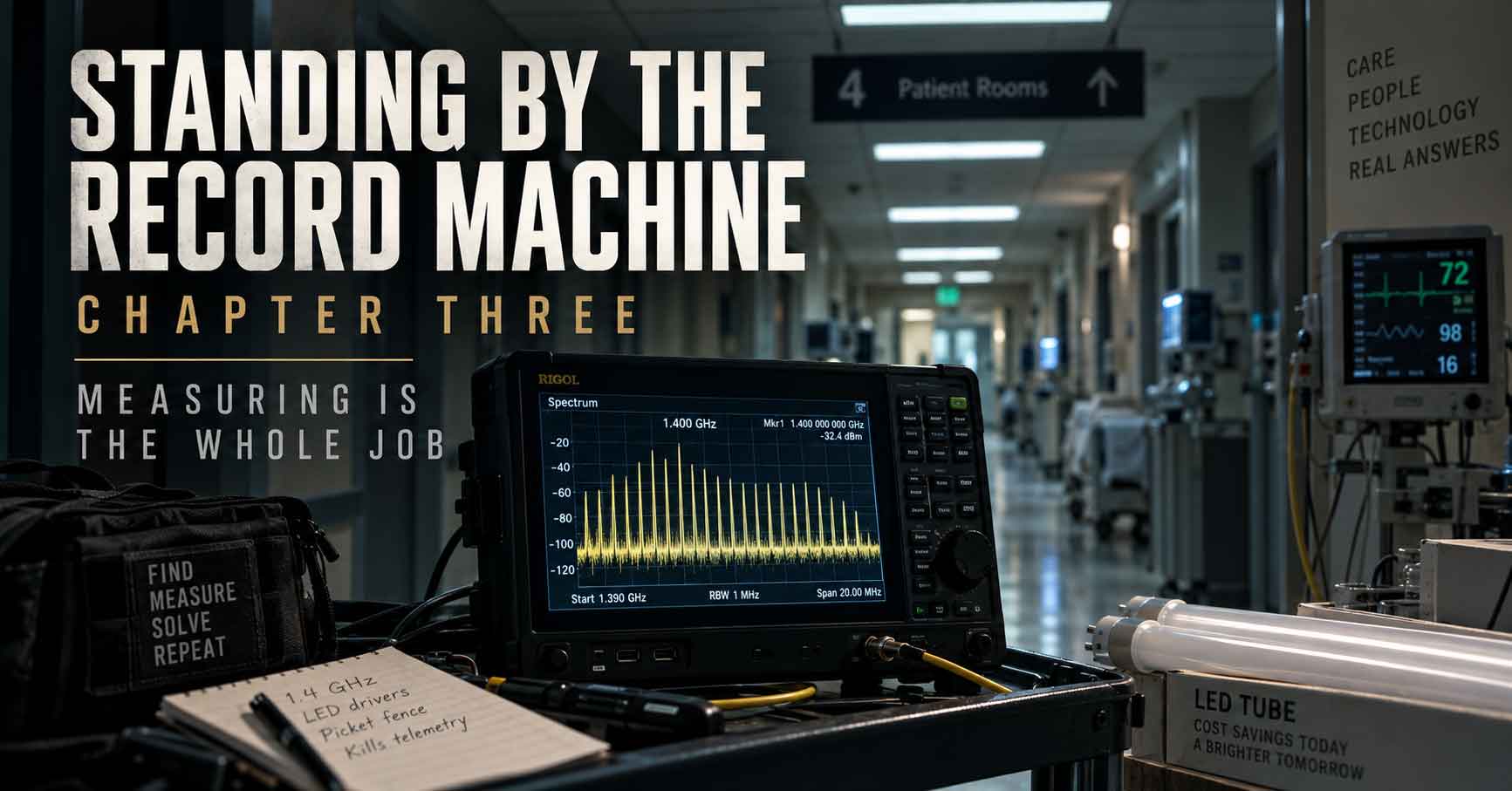
The telemetry lived where it always lived, in its own little protected neighborhood of spectrum around 1.4 gigahertz, and the interference was right there on the analyzer before he'd finished walking the fourth-floor corridor. Broadband hash, a picket fence of noise marching straight through the telemetry channels. Not 5G. Nothing like it. 5G is disciplined; it stays in its lanes because a great deal of money depends on it staying in its lanes. This was trash. This was something cheap, radiating because nobody had spent the forty cents to stop it.
It got louder toward the east wing. Louder still near the ceiling. It got loudest of all beneath a run of corridor lighting that the maintenance log said had been retrofitted, three weeks and two days ago, with LED tubes from a supplier whose name Ray had seen before, on other jobs, in other buildings, always in the same sentence with the word deal.
Cheap LED drivers. Switching power supplies with no filtering, a whole corridor of them, each one a tiny unlicensed broadcaster. Cold, they behaved. Warm, they sang. The retrofit had gone in three weeks ago, the lights warmed up over the course of the day, and every afternoon forty cardiac monitors tried to whisper through the noise and lost.
Forty minutes, dock to diagnosis. He spent another twenty proving it, because proving it was the difference between an answer and a story. Killed the breaker for that corridor run, watched the picket fence fall off the analyzer, watched the telemetry come back clean at the nurses' station. Threw the breaker, watched the noise stand back up. Three times more, because twice is a coincidence and four times is a mechanism.
"So it's the lights," Braden said, in the tone of a man rearranging his articles.
"It's the drivers in the lights. Send the tubes back, buy ones with an FCC mark that means something, and your heartbeats come home. You'll want that in writing for the vendor. I'll email it."
"Because honestly, everything I read pointed at the 5G."
"I know," Ray said. "It usually does."
There was a version of this conversation where he explained why. Why the tower was innocent, why the articles were wrong, why the thing everybody feared was the one thing on the roof actually following the rules, while the thing nobody feared was in the ceiling ten feet over the beds, humming through the monitors of people recovering from heart surgery. He had given that speech, or its cousins, for thirty years. It had convinced almost no one and it had cost him plenty, and at fifty-three he had finally learned to leave it in the van.
The fear wants a tower. It doesn't want a light fixture. A tower is somebody doing something to you. A light fixture is somebody saving forty cents, and nobody drives to Sacramento to protest forty cents.
He packed up, got his work order signed, and ate lunch in the van at the edge of the parking structure, in the shadow of the innocent tower, where the analyzer, out of habit, sat open on the passenger seat, sweeping.
Habit was most of what he was, now. He knew that and had decided it was fine.
Home was the apartment over the garage on his mother's old lot off Tennessee Street, behind the house where he'd grown up. The second bedroom had never held a bed: benches, racks, the good scope, the logs. Property tax was the only thing between Ray and needing a real job, and the logs were the only thing there he would have run into a fire for.
Thirty-one years of them. Green engineering notebooks to start, then a database he'd written himself and migrated faithfully across seven generations of dying hardware. Every job. Every measurement. Date, place, spectrum, cause, fix. It had started as professionalism and become something closer to a discipline, or maybe a tell. He wrote things down because written down was the only version of the past he fully trusted. His memory was fine. His memory was better than fine. He just didn't extend it credit, and he could not have told you exactly when that policy started.
Lynn had told him what it was, at the end, without raising her voice. That was the worst part. She'd had time to think about it. You trust the notebook more than you trust yourself. And then, because she was being honest and had decided to finish the job, more than you ever trusted me.
He'd wanted to say the notebook wasn't about her. That was true, as far as it went. He hadn't said it, because the rest of the sentence was and I don't know what it's about, and forty-nine had seemed too old to say that out loud to somebody who was already packing.
The marriage had lived in the front house, twenty feet from the bench, and most nights the light over the garage stayed on late. He had never thought of those twenty feet as a comment until she made them one.
Four years now. She was up in Santa Rosa. They talked when something broke that she didn't want to pay a stranger to fix, which was not never, and which they both pretended was about the furnace.
That was most of the family there was. His father had stopped trying sometime in the nineties. Before that, Ray had met his half-sister a handful of times, and remembered her mostly from one afternoon at the kitchen table of his father's apartment in 1991, when she was eleven and he was eighteen and she taught him a card game with her cards pressed flat against her shirt, accusing him of looking anyway, and beat him, and then argued for twenty minutes about whether she had explained the rules before he lost. That afternoon was the one he could still get all the way through. He had not seen her since. He did not know where she was. That was not unusual, for that side of the family, and he had filed it under not unusual for a long time.
He wrote up the hospital job that evening the way he wrote up everything, complete, timestamped, boring on purpose. Cause: unfiltered LED drivers, corridor run 4E. Fix: remove, replace, letter to vendor. Confidence: certain. He kept a confidence field in the database. In thirty-one years he had used the bottom of that scale three times.
Three jobs. Three folders in a directory he didn't open anymore, from three different years, three different counties. Energy on the analyzer with no transmitter behind it. Signals that were there, and then were not, and left nothing to send back the tubes on. He had worked each one until the client stopped paying and then a while longer on his own dime, and then he had written the only word he ever hated writing, unresolved, and closed the folder, and never quite deleted it.
Everything gets a cause. That was the faith. He preferred to be wrong about things he could put a probe on.
The email came in at 9:40, while he was closing out.
A substation operations manager down in Contra Costa, referred by somebody at the port job last spring. Polite, tired, a little embarrassed, the way they always were by the time they reached him. Recurring interference event, he wrote. Pattern established over several months. Vendor equipment cleared twice. Local RF survey inconclusive.
Then the sentence that Ray read three times.
We have a recording of the event, but our consultant says the recording can't be right, so we are hoping you can tell us what our equipment is actually seeing.
Ray sat with that one for a minute.
There were a hundred mundane ways a recording could lie. Front-end overload. Aliasing. A sample clock drifting in the heat. He could name the whole family tree of ways equipment sees things that aren't there, because equipment that lies was his bread and butter; if instruments never lied he'd have been replaced by instruments years ago. The consultant was probably right. The recording probably couldn't be right.
But he noticed, the way he noticed everything and logged almost all of it, that the manager hadn't written our equipment is malfunctioning. He'd written what is our equipment actually seeing, which was a different question. Which was, in fact, the right question, the one Ray had spent thirty-one years asking, the one almost nobody thought to ask because almost everybody skipped straight from the reading they didn't like to the conclusion that the reading was wrong.
Somebody down at a substation in Contra Costa had looked at an impossible recording and kept the question open.
The rate he quoted was his normal rate. He told himself that the little charge he felt closing the laptop was professional interest, and he wrote the job into the calendar for Thursday, and he did not look at the old directory, and that took a small, specific effort that he did not log anywhere.
Chapter Two - Chapter Four