
Standing By The Record Machine - Chapter Two
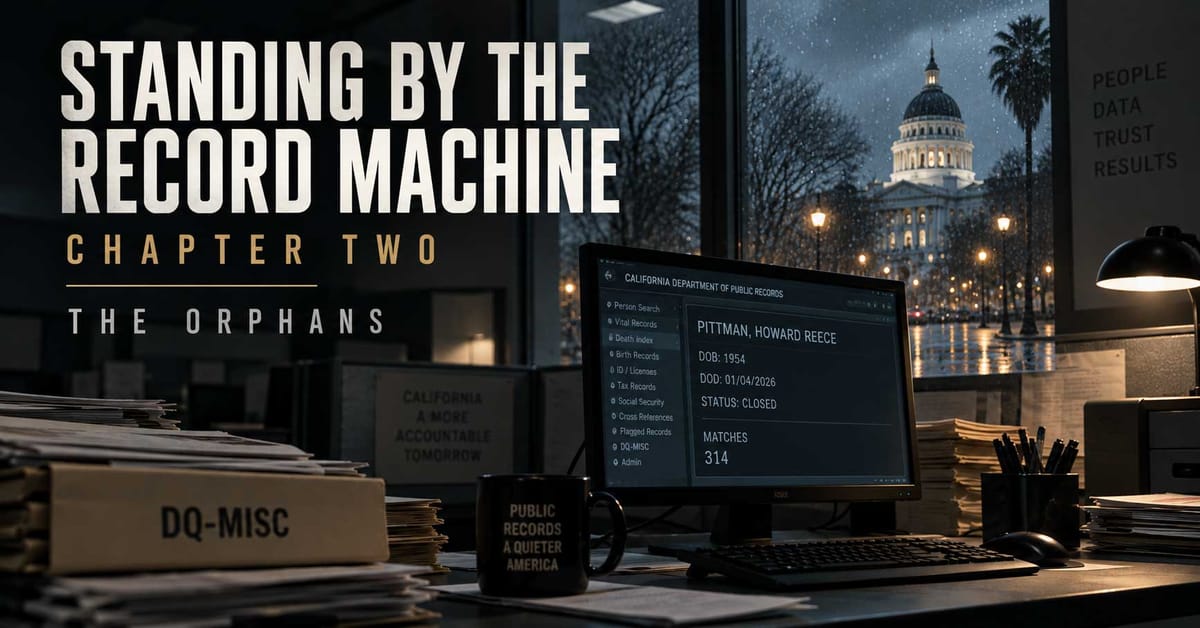
Delia Sandoval has spent eleven years finding people who shouldn't exist. Howard Reece Pittman is number 314: dead at two, back at thirty-five, with a paper trail too perfect to be real.
Tinkering with Time, Tech, and Culture #58
Chapter Two
Standing by the Record Machine
Sacramento, February 2026
The dead man's name was Howard Reece Pittman, and according to the State of California he had died in Modesto on the fourth of January at the age of seventy-one, of congestive heart failure, an attended death unremarkable in every way except that, as far as Delia Sandoval could determine, Howard Reece Pittman had died once already.
This was her ninth day with Howard. She was not in a hurry. The dead are patient and Delia had learned to be patient back, which was one of the things that made her good, maybe the main thing. The other analysts worked tickets. Delia worked people. A ticket you close. A person you follow home.
The death certificate was clean. Hospital record, clean. Social Security number, valid, and it resolved, the way a valid number is supposed to, to a real birth certificate: Howard Reece Pittman, born in Bakersfield in 1954, a real filing in a real county, two parents named, the ink of it properly old. The chain was whole. Birth to number to license to the bed in Modesto where he died. You could not have asked for a tidier life on paper.
It was the life off paper that wasn't there. When Delia walked the number upstream she found the river ran clear back to the birth and then, behind the birth, nothing, which was correct, a birth is a headwater. The trouble was downstream. Between the birth in 1954 and the first thing Howard ever actually did, a tax withholding in the summer of 1989, there were thirty-five years in which Howard Reece Pittman left not one mark on the world. No school. No vaccination. No father's signature on a form, though the father was named on the certificate. Thirty-five years of a person who was, on paper, alive, and who had done nothing living people cannot help but do. And then, at thirty-five, all at once, a working man, fully formed, paying in.
A real birth. A thirty-five-year silence. Delia knew what usually lived in a silence like that, and on the fifth day she went and found it, in the death index, filed in a different building under a different word: Howard Reece Pittman, Bakersfield, dead of a fever in 1956. Aged two.
A dead baby's name on a living man was not, by itself, a mystery. It was a crime, and an old and ordinary one, older than Delia, older than the state computers that were supposed to have ended it. You found a child who had been born and had died before the two facts were ever filed in the same place, and you took the birth and left the death, and you walked around inside a person who wasn't using their name anymore. There was a famous novel about it. Everybody in her line knew the trick.
So the mundane explanation was right there, and Delia spent nine days confirming it was true and useless, which were not the same finding, and only an amateur thought they were.
It was true. Somebody had ghosted the Pittman boy. But a ghost had a reason. A ghost was hiding from a warrant or a wife or a war, running to something or from it, leaving the fingerprints of a motive all over the borrowed life. Howard had no motive she could find anywhere in thirty-seven years. He had not hidden. He filed taxes. He renewed a license under a face no photographer had captured before 1989 and a thumbprint that belonged to no arrest, no enlistment, no prior anything, a thumbprint with no youth. He had used a dead child's name to do nothing but live quietly in Modesto and die attended, and the identity he had stolen had bought him not one thing a man steals an identity to buy.
That was the part the book didn't cover. Not a dead name on a living man. A dead name on a living man with no reason to wear it, and a thumb that started at thirty-five.
And then there were the other three hundred and thirteen just like him.
So at 4:40 on a Thursday, Delia did what she had done three hundred and thirteen times before. She opened a folder on her personal drive that was labeled DQ-MISC, which stood for data quality, miscellaneous, because a folder needs a name that makes people stop reading, and she added Howard to the file.
Three hundred and fourteen.
She called them orphans. Not out loud. Out loud they were unresolved legacy discrepancies, which was a phrase she had engineered over two administrations to be maximally soporific, a phrase you could put in a quarterly report the way you put a child to sleep. But in her head, and in the file, they were orphans: the living wearing the paper of the dead. Every one born real, every one buried young, every one somehow back, decades later, working and driving and paying in under a name that had a grave attached to it in a county that had never met a computer.
Eleven years of them. Most were like Howard, dead again now, elderly, the second death the one that forced the paperwork through her office and gave the only person who would ever notice her one chance to notice. A few, and these were the ones she thought about while brushing her teeth, were living. Present tense. Walking around Fresno and Eureka right now with driver's licenses and Costco cards and thumbs that started in adulthood, lives that had switched on at thirty or forty the way a movie sometimes starts in the middle of a sentence, borrowed from a child who never got to.
The department did not know the file existed in any organized sense, which was not the same as hiding it. Every orphan was also, individually, a properly documented case with a properly exhausted checklist. She had simply never seen a reason to mention that the impossible cases, filed separately, had a count. Counts made people excitable. Delia was never excitable, which was the other thing that made her good. In eleven years at Vital Records she had never once had a feeling she couldn't source.
Her cubicle faced a window that faced a wall, and taped to the monitor was the only decoration she permitted herself, a fortune-cookie slip a retiring supervisor had left on her desk her first year: EVERYTHING HAS A BORING EXPLANATION. She had kept it the way other people keep religious medals. It was the entire discipline in five words. The amateurs, the genealogy-forum people, the true-crime people, went looking for the interesting explanation first, and the interesting explanation was almost always a tired clerk in 1974. You worked the boring explanations in order of boringness and one of them was true. That was the whole method. That was the career.
Three hundred and fourteen times, none of the boring explanations had finished the case, and she had written down the count and gone home and slept fine.
Friday morning brought the weekly reconciliation run, four thousand new discrepancies between the state's records and everyone else's, ninety-nine percent of which would dissolve on contact. Marcus from the Social Security liaison desk drifted by at ten with his coffee and his weekly joke about how her customers never called to complain, and she gave him the weekly courtesy laugh, timed and sized like a stamp. She liked Marcus. He thought data was a place you visited. She lived there, and she knew the difference between a discrepancy and a resident.
Mid-morning, the run served her a flag that would have thrilled an amateur. A woman in Redding, past sixty, whose maiden name on her birth record didn't agree with the name on an old nursing license, two documents, forty years apart. The forum people would have been at her door by lunch with a cheek swab and a theory. Delia pulled the whole life instead, which took eleven minutes, and the life was immaculate. Birth to present, every index, every year accounted for, taxes and licenses and title transfers in one unbroken braid, the kind of file you could teach with. Somewhere in 1984 a clerk had transposed two letters of a married name, and the error had calcified into the record, and that was the entire mystery. One bad field in an otherwise perfect braid.
She cleared the flag. Clerical, closed, eleven minutes. If the records reconcile, the person reconciles. She had said that once at a training, not even meaning it as a saying, and it had ended up on a laminated card in the onboarding packet, which embarrassed her and which she also, privately, considered the truest sentence in the building.
At 4:15 she went back to Howard, because Thursday's work deserved a Friday review, and reviewed him, and he held. Impossible on Thursday, impossible on Friday. She wrote the closing note in her own file in her own format, the format no auditor had ever asked about:
No. 314. Pittman, Howard Reece. b. 1954 / d. 1956 / first activity 1989. Ghost confirmed. No motive found. Clean edge.
Clean edge. Her private term, from her first orphan eleven years ago, because that was what it looked like in the visualization tool when you laid a life out on a timeline: not the ragged fade-in of a bad record, gaps and stutters and partial hits, but an edge, sharp as a knife cut, nothing nothing nothing and then a whole man, mid-stride, fully formed, first pay stub, as if he had stepped through a door that wasn't there anymore. Bad data was ragged. This was clean. Bad data she could fix. Clean she could only file.
She saved the file and sat for a moment in the gray four-fifty light with her hands flat on the desk, which was as close as she came to ceremony.
Here was the thing she had never put in any report, the observation that lived where the count lived. In eleven years, the orphans had one other trait in common besides the edge. Their paper trails, once begun, were flawless. Not adequate. Flawless. Real people's records were a mess, because real people lost documents and skipped years and lied a little; a normal seventy-one-year-old file had mold on it somewhere. The orphans' files, from the edge onward, read like they had been kept by someone who had studied how a life was supposed to look, and was careful, and had no history to be careless with. The most reconciled people in the state of California were the ones who had died as children.
She logged off at five. Howard Reece Pittman stayed where she'd left him, in a folder engineered to be unread, in a count nobody knew existed, one more resident of the file where California kept the people it couldn't explain.
Monday there would still be thousands of discrepancies to work, and one of them would be fresh.