
Standing By The Record Machine - Chapter One
Berkeley, 1993. A young radio builder fixes a stereo at a party in the hills and discovers why a vivid memory can outvote the facts every time.
Tinkering with Time, Tech, and Culture #57
A brief note: I’ve been working on a new novel, Standing by the Record Machine, and I’m going to share it here chapter by chapter. This is Chapter One, set in Berkeley in October 1993. I hope you’ll follow along.
Berkeley, October 1993
The house was up in the hills on one of those streets that switches back so hard the mailboxes give up and cluster at the bottom. Ray came for the stereo. That was the deal Kellaway cut with the host: bring the kid, the kid fixes the left channel, you feed him.
Four minutes. Cold solder joint on the amp board, obvious as a flat tire. He touched it up with the iron he kept in the van with the antennas, and now the party had music in both ears and Ray had a plate of somebody's lentil thing, a beer, and nobody to talk to, which suited him fine.
He was twenty. Own van, own tools, and a reason to be in these hills that had nothing to do with anybody's parents. At a party like this that still made him furniture, which was also fine. Furniture gets to listen.
He was nobody's student. Never had been. The kids his age at Cal were a different species and both sides knew it. The hills were a place he came to fix things: they paid cash, they fed you, and they talked like you weren't in the room. Best deal in Berkeley.
It was a strange crowd, even for Berkeley. The host taught something at Cal, and her living room was two decades trying to share a couch. By the fireplace, the old guard: chemists, Deadheads, a guy who used to work at Livermore and told the story of why he left a little differently every time. Kellaway was over there being the Free Radio guy for a half circle of professors who collected him the way they collected first editions. He let them. They liked the edge fine; they liked it declawed. They got an outlaw for the evening, he got a room he'd never afford, and the kits still shipped Monday.
Around the kitchen, the new things: kids in thrift-store blazers arguing about whether the internet could be censored. Wrong question, Ray thought, but nobody asked him. A pitcher of smart drinks nobody touched twice. A glossy magazine on the coffee table, cover girl with circuit traces up her neck. In the back room a guy had a VR glove wired to a Macintosh and couldn't make it do anything, and there was a crowd around him anyway, watching the glove not work, completely satisfied. That told you most of what you needed to know about the back room.
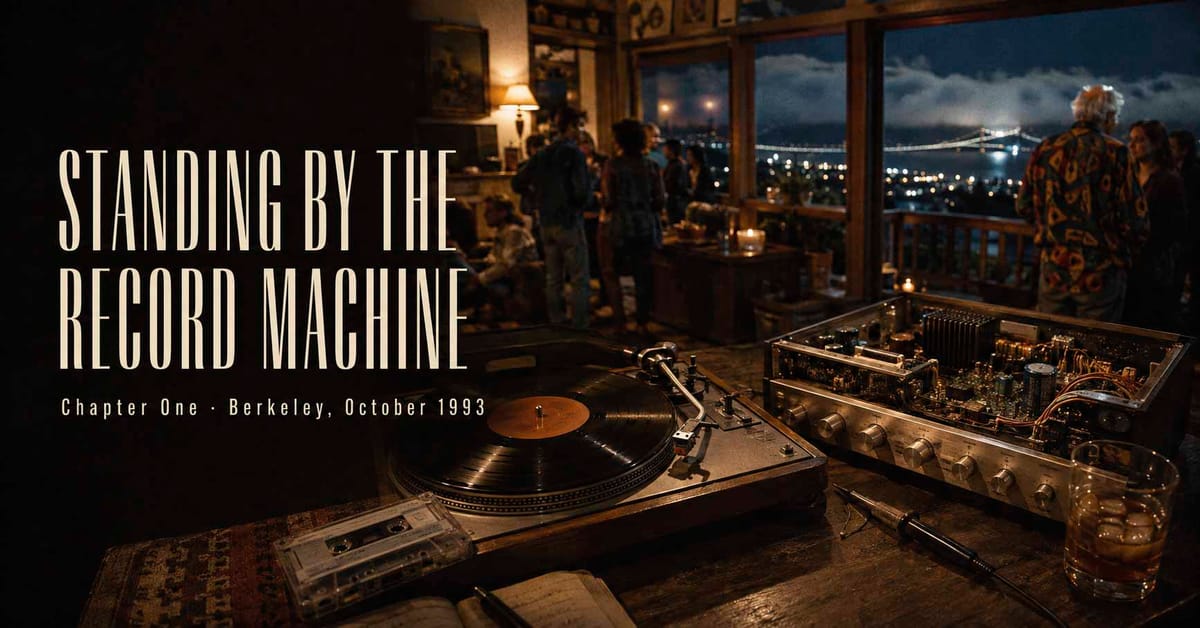
The deck hung out over the whole black bowl of the bay. Berkeley's lights ran down to the water, and the bridge sat there like a bench test. On the stereo Ray had fixed, somebody's mix tape was playing, and a big bearded guy stood next to the speaker singing along half a beat behind, standing there by the record machine, getting the words a little wrong the way everybody does. Nobody minded. That's what parties are for.
The mescaline story started around eleven.
Ray heard it build from across the room the way you hear an oscillation start, a low whine before anyone else notices, the same story rising through its second telling, louder now, the teller warming up. He was maybe forty, tweed jacket and sandals, the kind of guy who said when I was at Santa Cruz the way other men mention their army years. He had the corner of the room and he was using all of it.
"And this was mescaline, you understand. Real mescaline. Not some street thing. Yellow microdot, lab quality, my roommate got it from a guy who worked in a lab. And the thing about mescaline, you don't get this with acid, acid is cold. The thing about mescaline is the warmth. The whole quad was breathing. I stood in front of an ice plant for three hours. Three hours. I have never felt anything so organic before or since. Because it comes from a living thing. From the cactus. Your body knows the difference."
Somebody made an appreciative sound. The tape flipped. And Ray, who had told himself on the drive up to eat, listen, and touch nothing, said from the food table, not even loudly:
"It was acid."
The corner turned. The tweed guy smiled at him the way you smile at furniture that has spoken. "Excuse me?"
"Yellow microdot." Ray put down the plate and kept the beer. Some part of him, the part that watched him do these things, sighed and buckled in. "A microdot's a tab the size of a pinhead. Couple milligrams of material, total. Drug, binder, dye, everything. A dose of mescaline is three, four hundred milligrams. You can't fit a dose of mescaline in a microdot. It doesn't fit. Not won't. Can't."
The room did some arithmetic it didn't want to do.
"It fits if it's concentrated," the guy said.
"Concentrated isn't a thing you get to say about a molecule. The molecule is the size it is. You'd need a tab a hundred times bigger. What fits in a microdot is LSD, because acid works at a tenth of a milligram. That's why microdot acid existed and microdot mescaline didn't. Everything sold as mescaline on a campus back then was acid with a story stapled to it. Mescaline sounded warm and natural, acid sounded like the CIA. Same product, different label."
"I know what I took." The performance had gone out of his voice. "I was there. You were in diapers."
"You know what they told you that you took," Ray said. "Different instrument."
Which was, Kellaway told him later, a hell of a thing to say to a tenured anthropologist at his own colleague's party. It was also the reason the old man came over.
Ray hadn't noticed him listening. That bothered him afterward, because the old man wasn't a small presence. Tall even stooped, a big head of white hair, a Hawaiian shirt loud enough to pick up on a scanner, reading glasses pushed up on his forehead so he had to tip his head back to look through them, which gave him the air of a man forever letting you in on a joke. He came across the room carrying a glass of red wine he wasn't drinking, planted himself at the food table, and looked at Ray the way Ray looked at a clean signal.
"Three hundred milligrams for the sulfate," the old man said. "Although I should think one would feel two hundred, if one were fasted and the company were good."
A big unhurried voice, pure California, every sentence finished properly, like he'd never once been interrupted in his life. "The dye in the yellow ones. Do you happen to know what it was?"
"No idea."
"Neither do I," the old man said, delighted. "Whoever pressed them never wrote it down. Nobody writes anything down. It is the great tragedy of the criminal classes." He set the wine down, freeing both hands, and used them from then on to conduct himself. "Where does a young man of your age learn dose-response for phenethylamines?"
"A book."
"Which book?"
"Don't remember," Ray said, which was a lie, and the old man's eyes said he knew it was a lie and approved. A kid who protected his sources.
"Hm. And our friend over there." He did not look at the anthropologist, who had already rebuilt his corner and could be heard warming up again. "You corrected him beautifully and it accomplished nothing. He will be telling it again by midnight. Why?"
Ray shrugged. "People like the story."
"No. Closer." The old man leaned in. This was the part Ray would still be able to play back thirty years later, the exact voice, long after he'd lost the face that went with it. "The story is holding something up. Twenty years of him are stacked on that night. The cactus. The warmth. The ice plant. If the tab was acid, the night was ordinary. And if the night was ordinary, so is he. You did not offer that man a correction. You offered him a demolition. Nobody accepts a demolition free of charge."
"It's still wrong."
"It is completely wrong," the old man agreed, happily. "The chemistry is wrong, the dose is wrong, the supply chain is wrong. And he is not lying. That is the part I would ask you to understand. He has a memory. A good one. Vivid, sincere, and wrong, and it will outvote the fact every time the two are counted. Tonight. Next year. At his retirement dinner." He picked the wine up, considered it, put it back down. "Most people, offered the choice, will keep the memory and let the fact go. And they do not experience it as a choice. That is the interesting part. Not the drugs. The drugs were never the interesting part."
Out on the deck somebody set off fireworks left over from July, two thin whistles and a dud. Inside, the bearded guy had found his song on the other side of the tape and was singing the same line again, half a beat behind, same words, wrong words, happy.
"What's interesting," Ray said, "is that you can check. That's the whole thing. He could walk into a library tomorrow. The numbers are published. It's checkable, and he won't check, and if I stood there and made him watch me check, he'd still..."
He stopped. The old man was looking at him with an expression Ray had no name for.
"What is it you do, young man?"
"Radio. Transmitters. I build transmitters."
"For whom?"
"For anybody," Ray said, which in those hills in October of 1993 meant one particular thing, and the old man's mouth twitched like he knew exactly what it meant and had a federal opinion he was declining to share.
"A man who builds transmitters and checks things." He said it the way you read a label on a jar, checking the contents against the claim. Then he nodded once, like something had balanced, picked up his glass, and went. Not back to the party but through it, a straight line to the kitchen, where the host hugged him and the crowd folded around him, and Ray lost the white hair by degrees, like a signal going down into the noise.
"Do you know who that was?" Kellaway had materialized beside him, wearing the grin he wore when the world had performed for him.
"No." Kellaway told him.
"Huh," Ray said, and looked toward the kitchen. But the old man was gone, and it was late, and the amp was fixed, and there was a transmitter due Friday.
By midnight the anthropologist was telling it again; Ray could hear it from across the room. The quad, the warmth, the ice plant, three hours. Word for word, fully intact, like nobody had said anything to him at all.
He left before one, alone. Kellaway stayed; the collected always stayed late.
Here's the part that stuck, the part Ray chewed on driving his own van back down the switchbacks with the fog coming over the ridge: the guy wasn't wrong about the night. Something real happened to him on that quad. You could hear it in the telling. The label was wrong, that's all. Somebody sold him one thing in the wrapper of another, and he carried the wrapper for twenty years, and the wrapper became the thing, and no instrument on earth reaches it now.
And not just him. An entire graduating class walking around with a warm memory of a substance most of them never touched. Sincere, vivid, wrong. Not one liar in the bunch and not one of them right, and every single one of them certain, because the guy standing next to them remembered it exactly the same way.
Ray drove down into the flats, where the fog had already come in, and the streetlights went by overhead in long even rows, like the lit windows of something enormous passing the other direction.
He didn't think about it again for thirty-three years.
Chapter Two