
Standing By The Record Machine - Chapter Seven
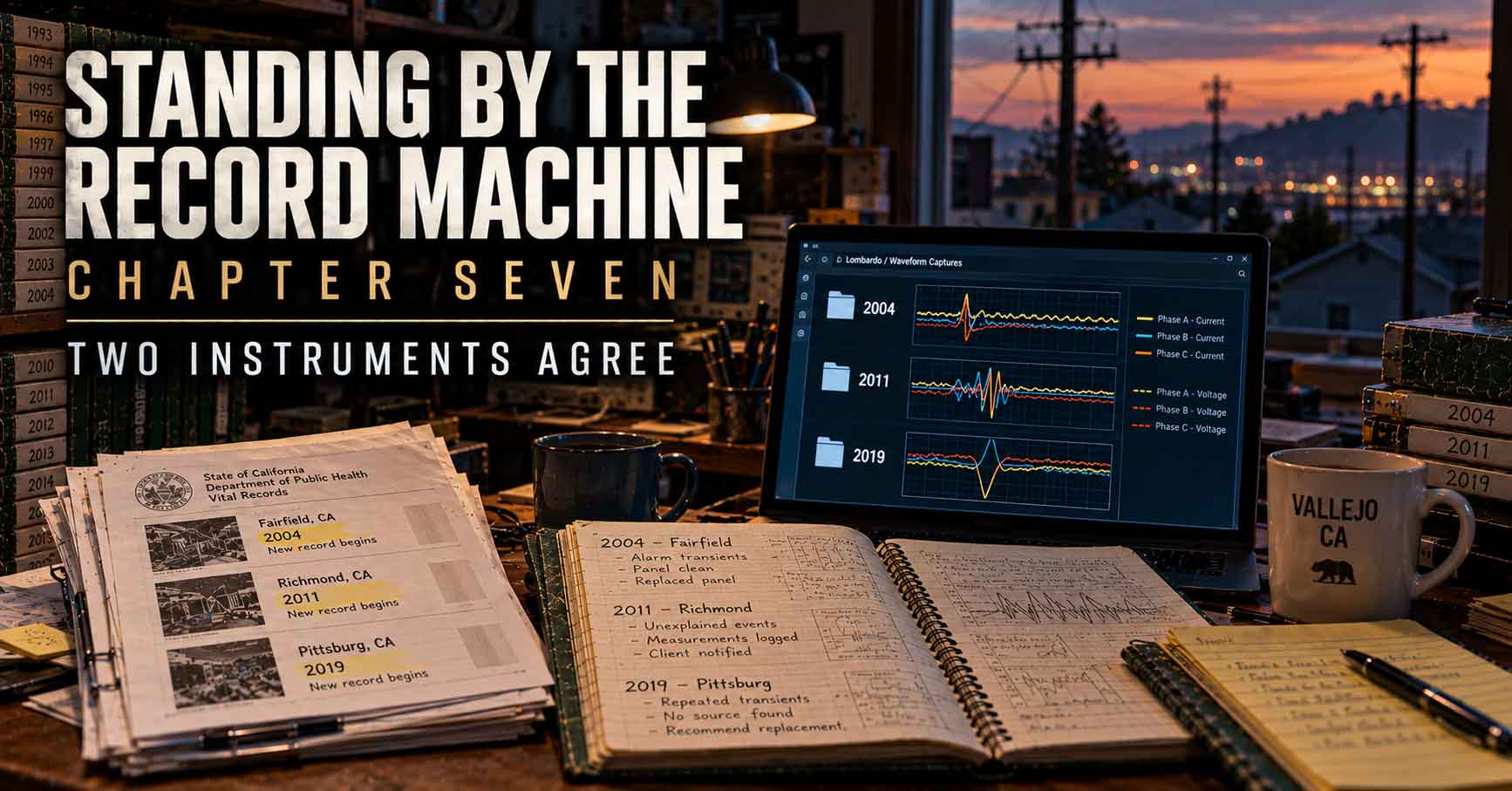
Delia brings Ray three impossible dates. His notebooks match every one. For the first time, two separate records of the impossible agree.
Tinkering with Time, Tech, and Culture #65
Vallejo, February 2026
Delia had gone and seen live ones before. Four times in eleven years, always on her own dime, always with a cover story shaped like a survey. She had stood on a porch in Eureka and asked a walking orphan about utility districts, and the woman had been pleasant and ordinary and had offered her lemonade, and Delia had driven home with nothing except the certainty that whatever was wrong with the world, it had good manners.
Raymond Lombardo was different, because Raymond Lombardo was not an orphan. He was the man standing next to them. So she prepped for him the way she prepped for an audit, which meant knowing his file better than he did, and she took the printouts but left the graves in the car, because you did not show your whole hand to a man you had no word for.
The forger theory was dead; his braid had killed it at her desk. What survived the weekend was worse: an independent contractor with a van full of equipment, called in after three impossible people began leaving records across fifteen years, and no theory left to hold him. She was driving an hour to look at the only common factor in eleven years of files, and she could not have written down what she expected to find.
The address off Tennessee Street was a deep lot, a low house facing the street and a garage in back with a flight of wooden stairs up its side, and the van in the gravel drive, older than she expected, antennas on a rack she didn't recognize. The unit letter on her printout took her past the house to the stairs. He met her at the top in a flannel shirt, reading glasses hanging from the collar, and the first thing he did was ask to see her state ID, which surprised her; then he put the glasses on and read it, front and back, which surprised her more.
"Sandoval," he said. "Vital Records. Long way from Sacramento for something administrative."
"It's a records reconciliation. Some county filings reference sites where you did contract work. I have questions about dates."
"Dates I can do," he said, and let her in.
The front room had been a living room once and was now something else, racks and benches and an oscilloscope older than she was, and one wall of green engineering notebooks, decades of them, spines dated in block ink. He offered coffee. She declined it, and he made himself one, unhurried, a man with nothing on his calendar and, as far as she could read him, nothing underneath. She had interviewed frauds. Frauds managed the conversation. Lombardo just answered things.
She gave him the first date. Fairfield, 2004, a distribution center, phantom fire alarm trips.
He didn't reach for memory. He reached for the shelf, pulled a notebook by its date, and opened it to the job in under a minute. Arrival time, equipment list, measurements, the client's name, what he charged. He turned it around so she could read it, unasked.
"Three days on site," he said. "Alarm panel was clean. Wiring was clean. I logged transients I couldn't source and told them to replace the panel anyway, because that's what you tell people when you can't source it. It didn't sit right then either."
She gave him Richmond, 2011. Again the notebook, the minute of page-turning, the record turned to face her.
She gave him Pittsburg, 2019, and he stopped.
He set the coffee down. He looked at her for a moment with an expression she couldn't file, and then he said, "Why those three?"
"I'm sorry?"
"Thirty-one years of jobs in that wall. Thousands of them. Boring, solved, every one. You drove down from Sacramento with three dates in your bag, and they happen to be the only three jobs in my working life I never closed." His voice stayed level, but something had come up underneath it. "Three unresolved in thirty-one years. You just named all three, in order. So before I show you the third notebook, you're going to tell me what a vital-records analyst reconciles that lands on exactly those."
The room was quiet. Delia sat with the folder on her lap. She was past her instructions, and his notebooks matched her file.
Protocol said thank him and drive home. She closed the folder and squared it and stood, and thanked him for his time, the sentence coming out as smooth as the hundred other times she had used it, and got two steps toward the door with the whole visit folded up and survivable behind her.
Then she stopped, her hand not quite to the knob, and heard herself say:
"On each of those dates, within a few hundred yards of your job site, a person's records began."
He didn't say anything.
"Began," she said. "The record doesn't say resumed. It says began. First activity of any kind, timestamped within the same afternoon as the transients in your reports. Three sites, three dates, three people who as far as the State of California is concerned started existing beside faults you were later called in to explain." She kept her voice in its work register, flat and exact, because that was the only way she could say the next part at all. "I came here because you were the only common factor. I'm telling you because your notebooks are the second copy."
"Second copy of what?"
"Of my file. I have dates and places where the records do something impossible. You have dates and places where the physics does something impossible. They're the same dates," she said. "They're the same places."
Ray got up. He went to the back room without a word and came back with a laptop, an old one, and sat with it a long moment before he opened anything. Then he turned it around, and there was a directory on the screen with three folders in it, dated 2004, 2011, 2019.
"Waveform captures," he said. "Energy with no transmitter behind it. I've had every explanation in the book and none of them survived. I don't open these anymore." He took off the glasses and rubbed his eyes. "People appearing. You're sure. You're sure the way I'm sure about these."
"I worked every mundane explanation. Nine of them, for days, for each one. I'm sure."
"Then we have two instruments," Ray said slowly, "that don't know about each other, agreeing." He said it the way other people say something is broken. "That's a measurement."
"There's a fourth," Ray said.
She looked up.
"Substation, Contra Costa. Same waveform family, and it's not historical. It's recurring. It was doing it last week; it'll do it again." He closed the laptop. "The other three I got called in after. Days after, weeks after. Cold. This one's live, and I'm going to be standing there with my own gear the next time it happens."
It took Delia a second, because records were about the past, and then the sum finished in her hands.
Three times, a signal, and then a person.
"If it's live," she said, "then somewhere near that substation, there's about to be a new one."
She heard the tense after she used it. There's about to be. The forum people's tense, three data points wearing it like a law, and the honest version, if the pattern holds, arrived half a second later and stayed behind her teeth.
Ray looked at her. Neither of them spoke. A truck went by on Tennessee. The coffee had gone cold beside the green wall of everything he'd ever measured.
"You should probably have that coffee now," Ray said. "This is going to take longer than you told your office."
Chapter Six - Chapter Eight